
Mitchel Stuffers
Assistant Editor at CIGH Exeter & PhD Candidate in History, University of Exeter
From an essay on geopolitics to an analysis of blue Texas, here are this week’s top picks in imperial and global history.
Geopolitics is for losers
Harold James
Aeon
Today everyone talks geopolitics. The idea is infectious. It appears to come from nowhere. Twenty years ago, the term was exotic, and the meaning behind it quaint. The world was different then. In 2002, America Unrivaled – a book edited by my Princeton colleague, G John Ikenberry, the foremost exponent of the idea of liberal internationalism – asked why there was so little resistance from other countries to American power projection. That was when the momentum in the United States for an attack on Iraq was building up. The contributors argued that there was no balancing against the unipolar moment that had been created with the disintegration of the Soviet Union: in short, no geopolitics. That changed in the course of the 2000s, and the word ‘geopolitics’ began its road to a dominance of political discourse.
There are simple numerical indicators (see Figure 1 below). A compilation of all newspaper uses of ‘geopolitics’ in English-language publications shows a remarkable increase, in two surges, one after the 2007-08 global financial crisis, and the second after 2014-15, in the aftermath of Russia’s annexation of Crimea and the European refugee crisis that followed the Syrian war. [Continue reading]
‘Thought to be lost forever’: After 2,000 years, a library buried by Pompeii’s eruption is finally revealing its secrets
Tom Howarth
ScienceFocus
When Mount Vesuvius erupted in 79 AD, choking the skies with ash and rock, few Romans living in its shadow could have foreseen the catastrophe about to unfold. For centuries, the volcano had been a silent giant, its slopes lush with vineyards and farmland, feeding the prosperous towns below. But in a matter of hours, everything changed. A towering column of superheated ash and gas shot miles into the sky before collapsing in deadly waves of pyroclastic flow. Entire towns – Pompeii, Herculaneum, Stabiae – were swallowed, their people entombed in a suffocating blanket of volcanic debris. It was a sudden and total annihilation. Yet, paradoxically, it was also an act of preservation.
For hundreds of years, archaeologists have painstakingly uncovered and studied these sites – brushing away the ash and pumice to catalogue frescoes, map streets and analyse ruins – especially when it comes to Pompeii. And yet, even after centuries of excavation, so many of its secrets have remained just out of reach. That is, until now. According to Dr Gabriel Zuchtriegel, director general of the archaeological park in Pompeii, we could be entering a new era of discovery in this small corner of Italy. “It’s a very interesting moment in archaeology, history and in general,” he says. [Continue reading]
Navigating national identity while your homeland commits atrocities
Emma Young
British Psychological Society (BPS)
The large-scale invasion of Ukraine by Russia in 2022 caused a wave of emigration, with people leaving not just Ukraine, but also Russia, out of fear for their personal safety. In fact, write the authors of a recent paper in the British Journal of Psychology, the fleeing of an estimated one million plus people from Russia in the year following the start of the war represented the biggest wave of emigration since the Bolshevik Revolution of 1917.
But how do emigrants feel about their identify after leaving their home, out of fear of persecution for their political views, or to avoid conscription into a war they did not support? In a bid to find out, a team led by Elena Mikhina at the Slovak Academy of Sciences conducted in-depth interviews with 12 Russian anti-war migrants. These people, of which four were men, were aged between 23 and 67. By the time of the second of two rounds of interviews, they had all lived abroad for at least one year, having resettled in various countries across Europe and central Asia. [Continue reading]
Pope Leo XIV votes in US midterm elections via mail-in ballot
Editorial Team
VaticanNews
VaticanNews
The Holy See Press Office confirmed on Friday [30 October] that Pope Leo XIV, an American citizen, has voted in the US midterm elections. “Pope Leo XIV has exercised his right to vote as a United States citizen, whenever he was eligible to do so,” according to a statement.
The Press Office confirmed that, “in keeping with this long-standing practice of civic participation, he has submitted his mail-in ballot in Chicago.” “The Holy Father has also confirmed that, during his years of residence in Peru he exercised his right to vote whenever he was eligible to do so,” noted the statement. “The Holy Father expresses his belief in the right and the duty of citizens to participate in democratic processes.” [Continue reading]
Political expert explains how Texas turned blue in massive election upset
Ahmed Humble
Chron
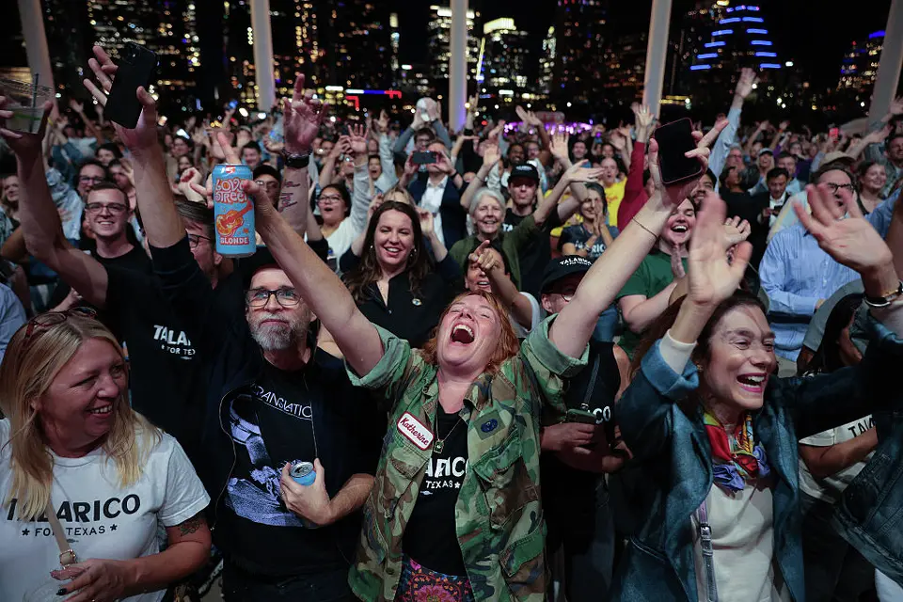
Texas Democrats have done the seemingly impossible and won the U.S. Senate race and the governor’s mansion, flipping two of the state’s biggest Republican strongholds. James Talarico defeated Republican Ken Paxton for the U.S. Senate seat, becoming the first Democrat elected to the Senate from Texas since 1988. Gina Hinojosa defeated Republican Gov. Greg Abbott, becoming Texas’ first Latina governor and the first Democrat to hold the office since Ann Richards left office in 1995.
What political experts say: For Mark Jones, of Rice University’s Baker Institute and longtime Texas political analyst, the size of the Democratic wave was the biggest surprise. “It was much larger than it’s been expected,” Jones told Chron. “I don’t think anyone had in the cards that it would be this good a year for Democrats, and this bad year for Republicans.” Jones said the result was driven by several factors coming together at once, with President Donald Trump’s unpopularity playing a central role. [Continue reading]


You must be logged in to post a comment.