
Mitchel Stuffers
Assistant Editor at CIGH Exeter & PhD Candidate in History, University of Exeter
From students ousting Serbia’s Vučić to Hitler’s mountain retreat in flames, here are this week’s top picks in imperial and global history.
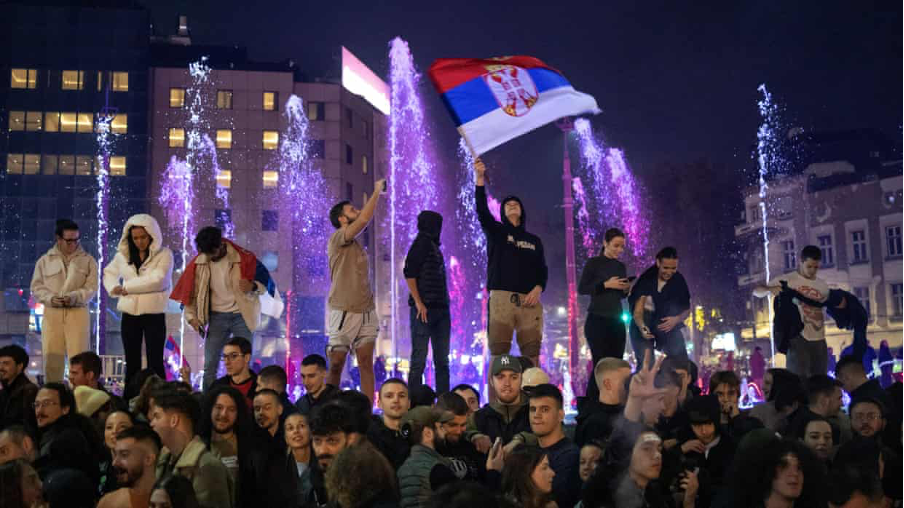
Serbian leader Aleksandar Vučić ousted by student movement in seismic election
Ashifa Kassam & Ana Milosavljević
Guardian
The long-serving leader of Serbia, Aleksandar Vučić, has conceded defeat, ushering in a seismic political shift after a historic election that saw the increasingly authoritarian leader pitted against a student-led movement that had spent two years protesting against his government. Vučić pointed to preliminary results that suggested voters had overwhelmingly backed the students, potentially giving them a majority in the country’s 250-seat parliament.
“We still do not have final results,” Vučić told supporters at his party headquarters in Belgrade. “On the basis of a sample … it is clear that we have lost these elections, the Student List has won, they will have between 135 and 140 seats and we will have 105.” A representative sample by the CeSID-IPSPS pollsters suggested that the Student List’s candidate list will have 138 deputies, while Vučić’s rightwing Serbian Progressive party (SNS) garnered 104 seats. he remaining seats were likely to be shared between ethnic national minority parties, said the pollsters. [Continue reading]
Podcast: “Fascists of the World, Unite? A History of Fascist Internationalism in the 1930s” with Martin Kristoffer Hamre
Martin Kristoffer Hamre & Roland Clark
New Books Network
(de Gruyter Oldenbourg, 2025) analyzes the ideas and forms of international cooperation between Fascist Italy, Nazi Germany, and fascist movements from Denmark, Norway, Sweden, Switzerland, Ireland, and Britain. The study examines how fascists attempted to unite across borders by forming international organizations and networks, hosting conferences and exhibitions, disseminating multilingual publications, and exchanging propaganda. Their transnational cooperation was fuelled by shared ideas of ultranationalism, anti-liberalism, anti-communism, antisemitism, racism, white supremacism, and Europeanism.
The book argues that fascist internationalism, marked by contradictions, limitations, and an Italo-German rivalry, emerged in the 1930s as a counter-reaction to liberal and communist internationalism. The epilogue discusses reverberations in the Second World War and the postwar period and outlines the relevance of this history for understanding contemporary forms of far-right internationalism. [Continue reading]
Sudan As A Mirror For Today’s World
Alden Young & Muez Ali
Noema
Sudan has often served as a mirror for judging the health of the liberal world order because it has repeatedly been a laboratory for multilateral interventions to prevent atrocities and stabilize the humanitarian situation. During the second Sudanese civil war, which stretched from 1983 to 2005, an estimated more than two million people died. In Darfur during the first decade of the 2000s, international observers estimated that 300,000 people died and another 2-3 million people were displaced.
At the time, finding a solution to Sudan’s conflicts was a priority for the United States and the coalitions it galvanized. For instance, Sudan’s second civil war came to an end only after intense mediation by the troika of the United States, the United Kingdom and Norway, as well as Sudan’s African neighbors, in 2005. The level of Western concern and diplomatic resources mobilized to intervene in Sudan’s conflicts in the early 2000s feels almost unimaginable today. [Continue reading]
Mold gold cape: A 3,900-year-old accessory that’s one of the finest examples of prehistoric goldwork ever found
Kristina Killgrove
LiveScience
In 1833, stone quarry workers discovered an ancient burial mound at Goblins’ Hill near the town of Mold in Wales. At the center was a stone-lined grave that contained a fragmented skeleton and a gold, cape-like accessory that had been crushed over time. The Mold gold cape has a unique shape and style, and it is one of the finest examples of prehistoric goldwork ever found, according to the British Museum, where the artifact is on display.
The cape dates to Britain’s Early Bronze Age (2500 to 1200 B.C.), a time that saw a metalworking revolution as artisans shifted from crafting flint tools to making weapons and jewelry out of gold, copper and bronze. When the cape was originally unearthed, experts assumed that it had belonged to an ancient warrior, chief or religious leader, due to the spectacular design of the object [Continue reading]
Suspect arrested over fire at Hitler’s ‘Eagle’s Nest’ retreat in Bavaria
Donna Ferguso
Guardian
Police have arrested a 33-year-old German citizen after a fire ripped through Adolf Hitler’s former mountain retreat in Bavaria, leaving the historic Nazi meeting place – known as the Eagle’s Nest – largely destroyed. About 200 firefighters were deployed on Friday night [23 October] to tackle the blaze at the Nazi dictator’s remote, purpose-built Kehlsteinhaus residence, a protected building on the peak of Obersalzberg in southern Germany. Flames rose high into the air as firefighters approached the scene to find the building “completely ablaze”, police said, adding that nobody was injured in the fire.
Lisa Maier, a police spokesperson, said firefighters struggled to tackle the blaze due to its location at an altitude of 1,834 metres (6,000ft). The building, which was one of the few undamaged monuments of the Hitler era, was only accessible with “heavy breathing apparatus”, she said. Built by the Nazis and formally inaugurated by Hitler on his birthday in 1939, the Eagle’s Nest has been preserved as a monument to “the insanity of the regime”, according to its website. [Continue reading]


You must be logged in to post a comment.