
This is the fourth blog post created by students of the 2026 ‘Linguistic Landscapes‘ Summer School at Venice International University, in conjunction with the University of Exeter and KU Leuven.
Martha Targett, Yi Lu
The area we explored was the Santa Marta area of the Dosorduro district of Venice (see picture below). It is an area of Venice which is highly populated by students, and there is a large student accommodation complex associated with the Ca’ Foscari University of Venice. The area we studied is also home to various university buildings relating to Ca’ Foscari University of Venice and IUAV University of Venice. In particular, the headquarters of the IUAV University of Venice are based here and the district is also home to many of the Ca’ Foscari humanities department buildings, which means that many of the students living in this area are humanities students. In accordance with this, a lot of the graffiti, stickers and posters from this area referred to left-wing ideas and political movements. Alongside the large student population, the area is historically a working-class area, and there is lots of social housing dating from the 20th Century.
While walking around the Santa Marta area of Venice, we noticed the substantial amount of graffiti. As a result, we decided that our study of the linguistic landscape of Santa Marta would be focussed on our research relating to the graffiti we observed while investigating this urban landscape.
Transgender rights
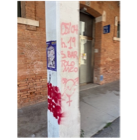
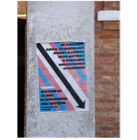
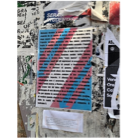
LGBTQ rights have become one of the most contested societal and political issues in Europe and beyond. While same-sex relationships are becoming increasingly accepted around the world, with countries granting gay couples legal rights to marry and raise children, transgender people are still facing severe discrimination. before example, J.K. Rowling, the author of the Harry Potter series, has constantly used her social media to backlash against transgender people (Miller, 2024). When we came across these signs on the campus, we immediately noticed the colour of the transgender flag, which consists of white, blue, and pink. But we realised that we actually knew very little about the queer life here in Italy. Are queer people legally protected? We then searched Wikipedia, and it says that “according to ILGA-Europe’s 2021 report, the status of LGBT rights in Italy is below the standards of other Western European countries – such as still not recognizing same-sex marriage, lacking nationwide discrimination protections for goods and services, as well as not granting to same-sex couples full parental rights, such as joint adoption and IVF. Italy and Japan are the only G7 nations where same-sex marriages are not recognized” (Wikipedia contributors, 2026). This gap between how Venice feels like a modern city to tourists and what the Italian law says de facto is part of what makes this site interesting.
The three signs represent different facets of transgender events that have happened in the city, which, when viewed together, create a full picture for local Italian-speaking residents. The first one is a piece of graffiti. There are handwritten words and a symbol combining the female sign with a cross-like mark, which is a recognisable feminist and anti-fascist symbol. There are only the date, time, and place with no explanation. It assumes that the reader already knows the context beyond the sign. But we can learn the context from other places. The second sign is a printed poster. The text reads “Rally in solidarity with a trans sister, against all violence and police coercion” (our translation). This is the event flyer register, which is usually clean, direct, and designed to be legible immediately from a distance. The third sign is a long-form statement, narrating a specific allegation against a police officer, who is said to have sexually assaulted two transgender women in December 2025. It also references a second incident, which refers to a transgender girl who was attacked by around 30 men outside a Mestre nightclub. It ends with the same call to attend the rally as indicated by the second poster.
In our view, these posters raise two issues. The first one is the problem of verifiability. The third sign uses a huge amount of text to reconstruct “what happened” in a single incident, but with zero citations, sources, or links. How does a passerby verify a claim like this? Street posters generally cannot carry footnotes, which is a structural limitation of the medium, but it also means that the poster’s persuasive power depends entirely on the trust in the poster-maker’s credibility rather than evidence-based transparency. Although the first incident in the text was reported by many newspapers, the second incident regarding the trans girl attacked by men outside the nightclub was not reported widely, which makes it difficult to verify the authenticity of the story. The second issue is the intertextuality in public space. Across all three signs, the same semiotic resource, the trans pride colours, reoccurs. This creates a kind of visual intertextual chain that enables someone who has seen one sign to recognise the authorship of the others even without reading the text, because the colours and symbols will act as a signature of the protest. Repeating visual codes can incorporate isolated posters into a sense of a connected campaign.
Soft protests
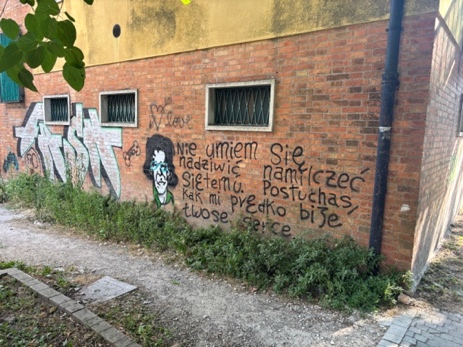
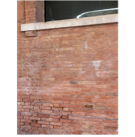
We also think that protests on the campus do not limit themselves to overt political activism, but that protests can also be blended into residents’ daily lives. The two pictures illustrate this point perfectly. The first sign features a mural of a face, which is accompanied by a quotation from Polish Nobel laureate Wisława Szymborska. The text is in its original language, which can be translated as “I cannot marvel at it enough, nor be silent enough about it. Listen to how fast your heart beats in me” (our translation). The second picture captures faint chalk writing on a brick wall, reading “I HAVE BEEN HAVING THESE WEIRD THOUGHTS LATELY”, alongside a sketch. This is a quote from the video game Kingdom Hearts (Quotes: Sora, 2026). Choosing this highly vulnerable medium of chalk implicitly challenges the authority of the city infrastructure without causing unnecessary damage. Both signs demonstrate that public walls are not just physical boundaries, but also emotional spaces, where soft protest for humanity, art, and literature happens, acting as a rebellion against the monotonous modern urban life. Notice also that both texts are in their original language without being translated into Italian to protect their authenticity, which also represents a refusal to conform to the linguistic hegemony of the city.
Final remarks
The signs that we came across in the Santa Marta area of Venice amplify the voices of local students who are dissatisfied with the current social, economic, and political realities of the city. They pasted posters and sprayed graffiti on places which are not designated for public expression, such as brick walls, noticeboards, and utility boxes. These signs become what Scollon and Scollon (2003) term in their classification of geosemiotics as “transgressive signs”, which are unauthorised and disruptive (p. 146). They turned the ordinary campus and residential areas into “public sphere” where debates and dialogues happen in a democratic society (Habermas, 1989). Future research could build on our findings to conduct a diachronic study and investigate how these signs evolve with the broader urban transformation in Venice, as exemplified by the study on protest and space at the University of Puerto Rico conducted by Martínez Vizcarrondo (2025). It would also be interesting to delve deep into the issues raised by these signs to reveal the extent to which the linguistic landscape could authentically reflect the current state of the city.
References
Habermas, J. (1989). The structural transformation of the public sphere. Cambridge: Polity Press.
Martínez Vizcarrondo, D. E. (2025). The protest in the space of the University of Puerto Rico. MIRCo. https://mircouam.com/en/archivos/7796 [Accessed July 28, 2026]
Miller, L. J. (2024). J. K. Rowling’s anti-trans rhetoric: populist transantagonism. Quarterly Journal of Speech, 110(3), 479–488.
Quotes: Sora. (n.d.). Kingdom Hearts Wiki. https://www.khwiki.com/Quotes:Sora [Accessed July 28, 2026]
Scollon, R., & Scollon, S. W. (2003). Discourses in place: Language in the material world. London: Routledge.
Wikipedia contributors. (2026, July 20). LGBTQ rights in Italy. Wikipedia. https://en.wikipedia.org/w/index.php?title=LGBTQ_rights_in_Italy&oldid=1365150063 [Accessed July 28, 2026]


You must be logged in to post a comment.