
This is the third in a series of blog posts created by students of the 2026 ‘Linguistic Landscapes‘ Summer School at Venice International University, in conjunction with the University of Exeter and KU Leuven.
Mona Mezhoud
Public space is never neutral. As Michel Foucault argues in his influential essay on heterotopias, places are always embedded in relations that either reveal or obscure power structures: heterotopias function as counter-sites where social orders are “simultaneously represented, contested, and inverted” (Foucault, 1986 [1984]: 24). Applied to Venice, this observation can be sharpened considerably — and, as the following comparison suggests, it is not merely an external theoretical import grafted onto the case. Tufi’s own linguistic landscape study of Venice arrives independently at the same framework, describing the city’s linguistic landscape as the product of a “dislocation of (real) place and the creation of a heterotopia” (Tufi, 2017: 89), a liminal space that is “simultaneously real and unreal.” Venice is no longer an everyday living space for its residents but a site where representation, contestation, and inversion of spatial order are constantly layered on top of one another under the sign of mass tourism. As Tufi notes, “In the LL [Linguistic Landscape] of Venice’s most visited areas there is evidence that Italian is undergoing a minoritisation process and, as a result, social levelling with respect to the languages ascribed to the main tourist groups” (Tufi, 2017: 85).
Language plays a central, though often underestimated, role in this negotiation of space. Norman Fairclough showed that language is not a neutral resource but a social practice that both reflects and (re)produces power relations (Fairclough, 1989: 26) — a framework applicable directly to Venice’s linguistic landscape, from multilingual, tourist-oriented signage to official municipal announcements: decisions about who may place which language where are never merely stylistic, but are always already questions of power.
This paper examines how a specific form of linguistic dominance has taken hold in the area around Santa Maria Maggiore in Venice, one that has increasingly adapted public space to an international, English-speaking tourism economy — and how this dominance has progressively marginalized the Venetian population, prompting residents, in turn, to reclaim that same space through language.
Methodology and Spatial Framework
Data were collected and uploaded to the Lingscape application [https://lingscape.app/], allowing photographs of linguistic signage to be systematically geo-tagged and mapped across the study area (Figure 1).
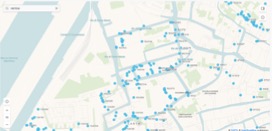
Figure 1
To read this data as more than an isolated accumulation of signage, the analysis draws on Kevin Lynch’s “The Image of the City” (Lynch, 1960 : 46-90), which conceives of urban space through five elements — paths, edges, districts, nodes, and landmarks. This division is closely tied to the area’s proximity to Piazzale Roma, one of Venice’s most significant transport nodes. Within the study area, only the Rio Nuovo itself functions as a touristic corridor in Lynch’s sense of a path: it channels a constant stream of visitors, generally recognisable by the luggage they carry, directly from Piazzale Roma into the wider neighbourhood. The streets and campi beyond this single corridor remain predominantly residential, giving the study area the character not of two adjacent zones, but of a narrow touristic passage cutting through an otherwise residential fabric (Figure 2). The following analysis traces this touristic–residential division through the linguistic landscape itself.
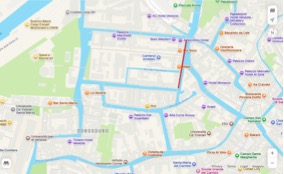
Figure 2
Theoretical Framework: Linguistic Landscape
A central reference point remains Landry and Bourhis’s classic definition of linguistic landscape as the “visibility and salience of languages on public and commercial signs in a given territory or region” (Landry & Bourhis, 1997 : 23). This focus allows linguistic presence to be read not merely as a means of communication, but as an expression of social order. The analysis captures the presence or absence of multiple languages, as well as hybrid linguistic forms, and interprets these regarding their social, symbolic, and power-related functions (cf. Shohamy, 2012: 539).
Analysis
Institutional versus commercial top-down signage
Before turning to commercial signage, it is worth establishing a contrasting baseline: how does the municipality itself use language within the same touristic corridor?
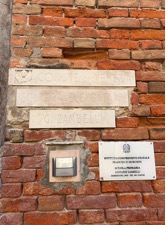
Figure 3
Figure 3 shows the inscription on the primary school “G. Zambelli,” carved in stone and marked with the crest of the Comune di Venezia. Unlike the market-driven signage discussed below, this institutional signage is monolingual Italian, and permanently so: carved rather than printed, it cannot be swapped out to follow shifts in visitor demographics. Sited within the study area’s residential fabric rather than along the Rio Nuovo corridor itself, the school marks a node of civic infrastructure serving residents, not visitors, in Lynch’s terms. This produces an asymmetry directly relevant to Fairclough’s framework: the actor with the greatest regulatory power over public space, the municipality, exercises none of the linguistic accommodation that the commercially dependent actors discussed below undertake voluntarily. Where language is permitted to shift with the market, and where it remains fixed by institutional authority, is therefore not a stylistic detail but, as argued above, a direct expression of power.
Top-down commercial dominance
By contrast, this dominance of English becomes immediately visible wherever signage follows a commercial rather than institutional logic. Figure 4 shows a menu board advertising “Happy Hour,” “Cocktail,” “Wine,” “Beer,” and “Take Away” — entirely in English, except the loanword “Spritz.” As business-produced signage addressing an international clientele, it exemplifies the salience Landry and Bourhis describe: English is the unmarked default.
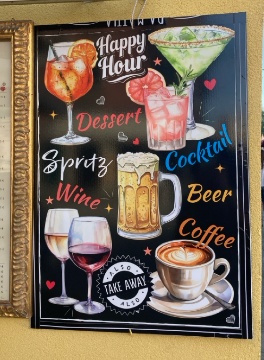
Figure 4
The symbolic and ironic function of Italian
Elsewhere, Italian-language elements serve a symbolic function, projecting an impression of authenticity for visitors. Figure 5 shows a sign in the window of the Hosteria Venexiana, a restaurant whose name adopts the Venetian dialect spelling “Venexiana” rather than the standard Italian “Veneziana,” and which displays an untranslated, humorous local saying: “Vietato entrare di cattivo umore” [“No entry in a bad mood” — translation mine]. Neither the dialect marker nor the joke is rendered in English; authenticity here depends precisely on the absence of translation, addressing a public assumed to read Italian. This authenticating function is not always stable, however, as the following example shows.
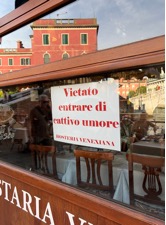
Figure 5
Figure 6 shows a stenciled winged Lion of St Mark — Venice’s heraldic emblem — fitted with Mickey Mouse ears. Rather than asserting tradition, the image ironises it: the symbol meant to guarantee an “authentic” Venice is depicted as already absorbed into theme-park logic, evoking a satirical “Veniceland.” The stencil’s placement is not incidental: located along a principal route toward the train station, it is encountered primarily by arriving and departing visitors, situating this critique within the flow of tourist mobility identified through Lynch’s node.
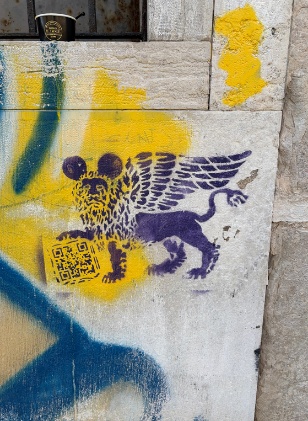
Figure 6
Bottom-up resistance and the reclaiming of public space
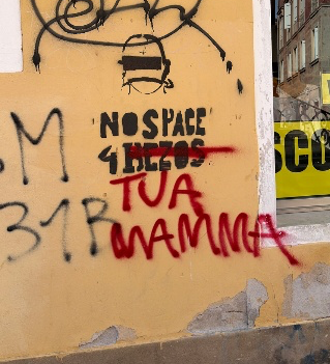
Figure 7

Figure 8
Figures 7, 8, and 9 extend this critique toward explicit, organised protest. Figures 7 and 8 target the marketing of the city as a backdrop for private events, exemplified by the widely publicised wedding of Jeff Bezos and Lauren Sánchez in Venice in June 2025. Ahead of the ceremony, a coalition of local housing, anti-cruise-ship, and student organisations mobilised under the banner “No Space For Bezos,” protesting the wedding as emblematic of the city’s exploitation amid overtourism and rising housing costs. The graffiti in Figure 7 — an English phrase reading “No space for […],” overwritten in red with the Italian retort “tua mamma” — can plausibly be read as a direct echo of this slogan: a globally circulating protest idiom literally written over by a local, vernacular voice. This critique is made explicit in Figure 8’s sticker: “Nel tempo che impieghi a leggere questo articolo, la ricchezza di Jeff Bezos è aumentata di più del tuo stipendio mensile. Tassare i miliardari” [“In the time it takes you to read this article, Jeff Bezos’s wealth has increased by more than your monthly salary. Tax the billionaires” — translation mine].
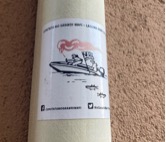
Figure 9
This protest is not confined to a single event. Figure 9 documents a sticker for the Comitato No Grandi Navi (“No Big Ships Committee”), reading “Laguna Bene Comune” — a movement active since the early 2010s opposing cruise ships in the lagoon. This situates present protests within a longer tradition of grassroots activism. Crucially, “bene comune” reframes urban ownership in terms of the commons: the lagoon, and the city itself, is claimed not as private or touristic property but as a resource held collectively by residents.
Conclusion
Taken together, these findings trace a linguistic landscape structured by two opposing logics of spatial appropriation. On one side, top-down, commercially produced English dominates the touristic corridor, marginalising Italian to a symbolic role — precisely the “minoritisation” Tufi identifies. On the other, a bottom-up, Italian-language counter-landscape of stencils, graffiti, and stickers stages visual resistance: an attempt to reclaim public space through language, and to question to whom that space ultimately belongs. Read through Fairclough’s language-as-struggle and Foucault’s heterotopia, these findings suggest that Venice’s public space functions as a linguistic battleground: one in which residents do not merely inhabit a tourist-configured city, but actively write back against it.
Bibliography
Fairclough, Norman. Language and Power. 1st ed. Longman, 1989.
Foucault, Michel. “Of Other Spaces.” Diacritics, vol. 16, no. 1, 1986 [1984], pp. 22–27.
Landry, Rodrigue, and Richard Y. Bourhis. “Linguistic Landscape and Ethnolinguistic Vitality: An Empirical Study.” Journal of Language and Social Psychology, vol. 16, no. 1, 1997, pp. 23–49.
Lynch, Kevin. The Image of the City. MIT Press, 1960.
Shohamy, Elana. “Linguistic Landscapes and Multilingualism.” In Martin-Jones, Blackledge, and Creese (eds.), The Routledge Handbook of Multilingualism, Routledge, 2012, pp. 538–551.
Tufi, Stefania. “Liminality, Heterotopic Sites, and the Linguistic Landscape: The Case of Venice.” Linguistic Landscape, vol. 3, no. 1, 2017, pp. 78–99.


You must be logged in to post a comment.