
Adrienne Roberts & Silke Trommer
University of Manchester
Over the past decade, trade policy elites around the world have begun acknowledging that global trade has gendered effects, and that women are among the social groups that tend to bear a disproportionate share of its costs. Since 2016, they have engaged in a range of gender mainstreaming efforts in trade, the majority of which aim to connect women entrepreneurs and traders to global markets, which is presumed to generate economic opportunities and gender equality across the economic and social spheres. But where did this focus on gender equality and women’s economic empowerment come from, given that, since the days of the General Agreement on Tariffs and Trade (GATT), global trade policy elites have consistently told feminist critics that trade is ‘gender-neutral’? What does the mainstreaming of gender into trade policies, rules and agreements mean for gender-based and other forms of inequality and exclusion in the world economy?
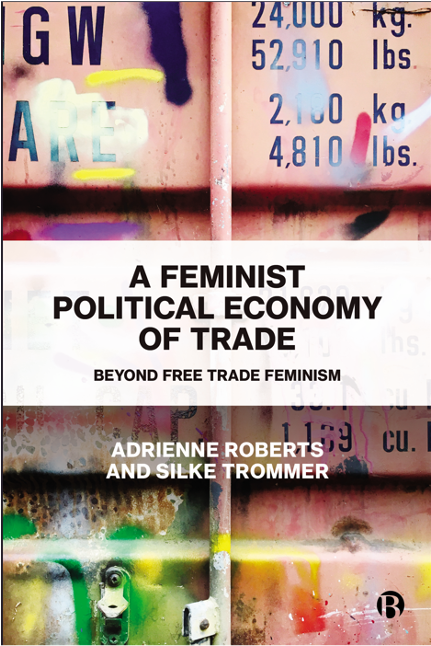
These are the key questions tackled in A Feminist Political Economy of Trade, which develops an original feminist political economy framework and uses it to document, historicise and critically analyse the emergence of gender mainstreaming in trade. Part of the problem, as we see it, is that insofar as feminist groups were actively engaged in mobilizations against free trade in the 1990s and 2000s – for instance against the North American Free Trade Agreement (NAFTA) and the anti-World Trade Organization (WTO) ‘Battle of Seattle’ protests – the current approach to gender mainstreaming being driven by the WTO, among others, has been a mostly top-down affair.
It would be overly simplistic to say that this was entirely driven by Roberto Azevêdo, who was the Director General of the WTO between 2013-2020, and who was also a member of the International Gender Champions leaders network. But he did play an important role and was encouraged by the likes of Cristine Lagarde who, as its Managing Director, brought gender mainstreaming to the IMF (of all places!). So too did civil servants working across various trade governance institutions and political leaders in a number of countries, including Canada, Chile, the EU, Iceland, and the UK, among others, who have increasingly integrated standalone gender chapters into trade agreements.
The argument we make in A Feminist Political Economy of Trade is that gender mainstreaming in trade governance emerged largely from within the institutions and political elites responsible for shaping the existing trade order. It was therefore perhaps inevitable that it would take a relatively reformist form, seeking to make trade policy more gender-responsive and to enable women and others to benefit from trade without fundamentally questioning the political-economic structures that underpin it. It is precisely these structures, and the ideologies and institutions within which they are embedded, that need to be analysed and challenged from a feminist perspective if trade is to undermine rather than reproduce gender-based and intersectional inequalities globally.
In order to do so, we offer a counter-history of global trade that explains how gendered inequalities and trade inequalities have been co-constitutive across the historical evolution of the capitalist world economy. We posit that both the material practices of capitalist trade, and the ideas and institutions through which global trade relations have been managed, are intrinsically linked to gendered power relations.
We organise our counter-history around three conceptual devices. These devices allow us to ontologise the inherently gendered nature of global trade and explain how gendered power relations permeate trade governance today. First, we build on Maria Mies’ conceptualization of ‘housewifization’, which describes the process through which capitalist patriarchy harnesses various types of non-waged work to the global economy while simultaneously externalizing, naturalizing and devaluing this work. As Immanuel Wallerstein and others forcefully argued in the 1970s and 80s, colonial divisions of labour, including forced labour, were central to shaping unequal trading relations in the world economy, which persist to this day. Housewifization draws attention to how these colonial labour relations are gendered, and how they are structurally connected to the non-waged reproductive labour (largely performed by women) in households in both the colonies and the imperial centres. This labour is central to the dynamics of capitalist accumulation despite being feminized, invisiblized and devalued. A contemporary manifestation of this can be seen in efforts on the part of the trade community to connect women ‘entrepreneurs’ to digital platforms where they can engage in digital trade while simultaneously performing unpaid domestic and care labour. Here, gendered ideas about the benefits of ‘flexible labour’ serve to mask the exploitation of by Big Tech firms across the productive/reproductive divide.
Second, ‘trade productivism’ refers to trade theories and governance techniques that are dominated by masculinist rationalities and values. While trade theories and governance practices have varied considerably over time, we show how the ideas about gender, social reproduction and the family that were present in the period of classical liberalism were gradually erased from trade theory and practice. Indeed, the trade institutions that were created in the wake of the 1944 Bretton Woods Conference, most famously the GATT, were almost perfectly gender-blind. Not only were women under-represented in the institutions, but economic issues relevant to women or to feminized types of labour were almost never acknowledged. For instance, subsistence agriculture was largely ignored, while the broader question of agricultural trade (in which many poor countries have a comparative advantage) was excluded from GATT negotiations and rules. Trade theories were implicitly premised on ideas of the individual operating as ‘a rational economic man’ while trade rules focused primarily on masculinized parts of the economy.

Third, ‘trading on social reproduction’ captures a shift that took place in the decades leading up to the new millennium whereby more and more aspects of lifemaking, or what feminists call ‘social reproduction’ have been drawn into trade. When the WTO replaced the GATT as the world’s multilateral trade governance body in 1995, it introduced novel types of regulation in relation to services and investment and intellectual property protection. While these areas are largely overlooked by current gender mainstreaming efforts led by the WTO, the subjection of crucial areas of public policy and innovation, including medial innovation such as medicines and vaccines, to trade disciplines impacts populations along gender lines, as women disproportionately use and work in many of these areas, and their unpaid labour acts as a social safety net of last resort when services are cut. The WTO also for the first time brought agriculture trade systematically under multilateral trade disciplines. At the same time, the spread of global value chains has intensified the feminization of labour and of the conditions of work globally.
A Feminist Political Economy of Trade shows how these structural gender dynamics are overlooked by dominant gender mainstreaming initiatives being pursued today. As such, gender mainstreaming risks actively reproducing historical gender inequalities, while creating new forms of domination and exploitation, including in the increasingly commercialized and digitized agricultural sector. This calls for a radical alterative. As Diane Elson notes in her endorsement of the book, “as the hegemony of trade liberalization breaks down, this book points to ways in which we might press for forms of international trade that are oriented to well-being rather than profit.”
Dr Adrienne Roberts is Senior Lecturer at the University of Manchester and Director of the Political Economy Centre.
Dr Silke Trommer is Senior Lecturer at the University of Manchester and Director of the Manchester Jean Monnet Centre of Excellence.


You must be logged in to post a comment.