
Mitchel Stuffers
Assistant Editor at CIGH Exeter & PhD Candidate in History, University of Exeter
From the restitution of looted colonial objects to a unique historical narration by glassblowing, here are this week’s top picks in imperial and global history.
The Restitution of the Diamond of Banjarmasin
Anne van Mourik & Klaas Stutje
NIOD Rewind
The Diamond of Banjarmasin, a diamond looted by the Dutch in 1859 and sent to the Netherlands two years later, will be restituted to Indonesia. Anne van Mourik talks about the restitution with Klaas Stutje (Expert Centre Restitution NIOD). How does the restitution of looted colonial objects actually work? What does it mean to return such a colonial object, and can we see it as a form of transitional justice? And what histories does the diamond reveal? The podcast discusses an in-depth article that Klaas Stutje wrote about the diamond for The Rijksmuseum Bulletin. The article is available to read here. Listen to the NIOD Rewind podcast via the link above or on your favourite podcast platform. [Continue reading]
Thatcherism via the Walkman: Stuart Hall’s British cultural studies preserved online
Chris Osuh
Guardian
Whether it was Thatcherism, populism or the story of the Sony Walkman, Stuart Hall was a public intellectual famed for defining the times. Now a major digital archive of his previously unpublished papers, notebooks, recordings and videos has been launched. When the Jamaica-born sociologist and seminal figure in postwar Black British history died in 2014 aged 82, his obituary in the Guardian said he had been “among the first to identify key questions of the age”. Hall coined the term Thatcherism and in 1985 warned of the dangers of “authoritarian populism”. The University of Birmingham, where Hall developed the Centre for Contemporary Cultural Studies, has digitised and released more than 3,100 items donated by his widow, the historian Catherine Hall. [Continue reading]
UK PM Burnham says ‘status quo’ with Brussels ‘not good enough’ as he details upcoming EU summit
Nathan Rennolds
EuroNews
British Prime Minister Andy Burnham said the UK’s relationship with Brussels needs to change as he spoke to parliament ahead of next month’s UK-EU summit. Burnham told MPs that “sticking with the current status quo is not good enough for Britain” and that a conversation over future relations must be had “if we are serious about promoting growth, controlling immigration, upholding our values and security.”
“Worse, it would be a major dereliction of duty” for the government to “turn away” from exploring options for a closer relationship with the European Union, he continued, adding that his “immediate priority” was to land a “successful outcome at the summit,” which is scheduled for 20 November. He stressed that the British public would “be the boss” at “every stage” of the process. [Continue reading]
Lobbying, lawyers and a media blitz: the fight to kill the Church of England’s £100m slavery compensation fund
John Collingridge
Guardian
“This is virtue signalling,” said Nigel Biggar. “These are elites who are trying to demonstrate that they are being progressive.” The target of his scorn was one that has obsessed him for years: the movement to pay reparations for the slave trade, and specifically the Church of England’s plan to spend £100m atoning for its involvement.
“I’ve got north of 100 parish churches in my constituency, many of them crumbling,” added Katie Lam, an up-and-coming Conservative MP and immigration hardliner. Lord Biggar, a retired professor, Conservative peer and Anglican priest, was speaking alongside Lam last September on a Spectator podcast named after his latest book, Reparations: Slavery and the Tyranny of Imaginary Guilt. [Continue reading]
How Dima Srouji Uses Palestinian Glassblowing to Explore Archaeology, Colonialism and Craft
Maghie Ghali
Arabian Business
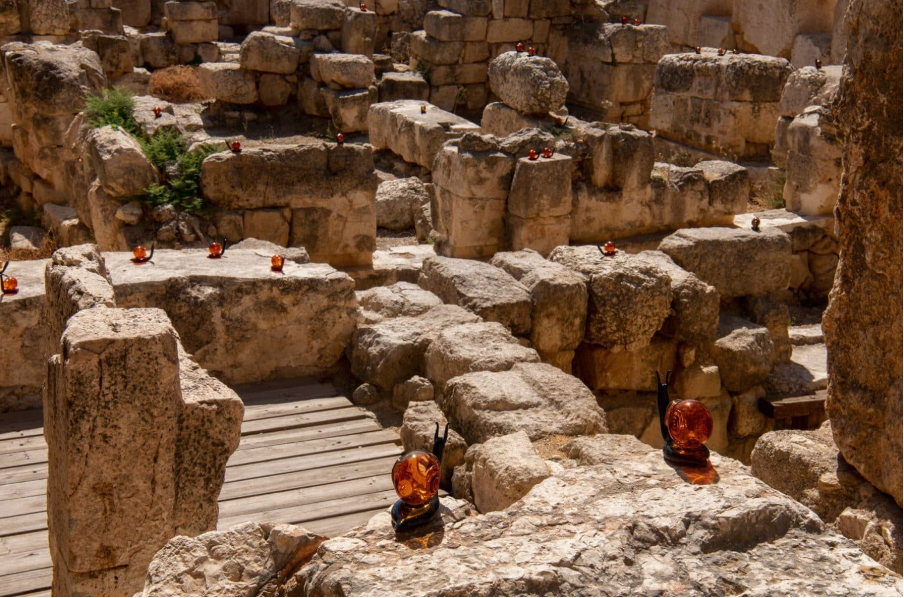
About an hour’s drive from Amman sits the Hellenistic ruin of Qasr Al Abd in the rural valley of Iraq Al Amir, an undulating landscape of olive groves and fig trees. While locals have long visited during harvest season to sample the land’s bounty, the ancient palace from the 2nd century BCE is often overlooked. Now, as part of Amman Design Week (Oct 2-17), Palestinian designer and architect Dima Srouji has covered the ruins with 200 glass snails and figs. Titled “Natural Residents,” the installation invites people to imagine the stone palace as more than a static relic disconnected from its surroundings. Though the palace was never finished, and so never inhabited, Srouji sees her glass figures as the ruin’s first residents.
Srouji’s practice is research-driven at its heart, delving into untold histories, a methodical exploration of materiality and practices embedded in Levantine culture. Drawing on a 1904 diary by archaeological surveyor Frederick A. Norris at Qasr Al Abd, which described abundant waters — a moat and springs — and snail fossils. “I was thinking about past and present ecologies of Iraq Al Amir, and trying to bring them back into an archaeological site that’s also a living public space and not just a ruin frozen in time,” Srouji tells T MENA. [Continue reading]


You must be logged in to post a comment.