
Marc-William Palen
History Department, University of Exeter
Marc-William Palen
History Department, University of Exeter
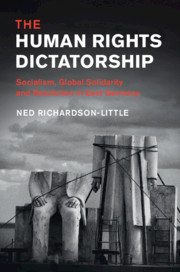
Ned Richardson-Little. The Human Rights Dictatorship: Socialism, Global Solidarity and Revolution in East Germany. New York and Cambridge: Cambridge University Press. 2020. £22.99 Paperback
Interviewed by Marc-William Palen
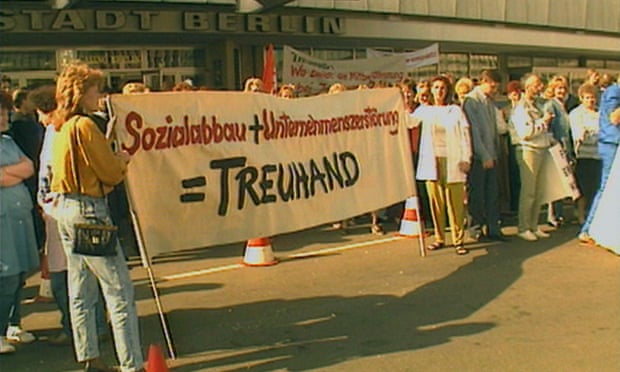
Ned Richardson-Little’s The Human Rights Dictatorship recovers the history of human rights within the German Democratic Republic (GDR). In doing so, he provocatively reinterprets the Cold War, the evolution of human rights in the Eastern Bloc, and the revolutions of 1989. The book provocatively shows how “human rights” had multiple meanings depending upon which side of the Cold War – and the Berlin Wall – you found yourself. Richardson-Little’s tracing of how the meaning of human rights evolved in the decades after the Second World War illuminates a global battleground of ideas that continued to be fought in Eastern Europe long after the tearing down of the Berlin Wall.
Dr Richardson-Little is a Freigeist Fellow at the University of Erfurt, Germany, where he leads a project on international crime and globalization. Before this, he was a postdoctoral fellow in the 1989 after 1989 research group (2014-18). He received the Fritz Stern Dissertation Prize from the German Historical Institute (Washington) and a commendation from the Fraenkel Prize committee at the Wiener Library. Academic publications include numerous chapters and journal articles, and the editing of a special issue of East Central Europe. He has also written for the Imperial & Global Forum, and hosts a blog, History Ned. You can follow him on Twitter @HistoryNed.
How would you briefly summarize your book? Give us your “elevator pitch,” if you will.
The idea of human rights was crucial to the fall of the Berlin Wall and the collapse of state socialism in East Germany, but before that, it had also been a core part of communist ideology used to legitimize dictatorship. The ruling Socialist Unity Party (SED) came to see itself and the German Democratic Republic as a champion of human rights, both at home and around the world. The party even created a socialist version of Amnesty International to campaign on behalf of victims of human rights violations in West Germany and beyond. For dissident activists, creating a human rights movement wasn’t a matter of being inspired by the West, but reclaiming the idea of human rights from the state by demanding democracy and pluralism from within. The SED was able to use human rights politics to sustain power for decades, but once dissident groups succeeded in wresting it from the party, this accelerated the process of collapse leading to the fall of the Berlin Wall in 1989. Continue reading “The Human Rights Dictatorship – An Interview with Ned Richardson-Little”
Marc-William Palen
History Department, University of Exeter
Continue reading “This Week’s Top Picks in Imperial & Global History”
Zoltán Ginelli
Excerpted from LeftEast
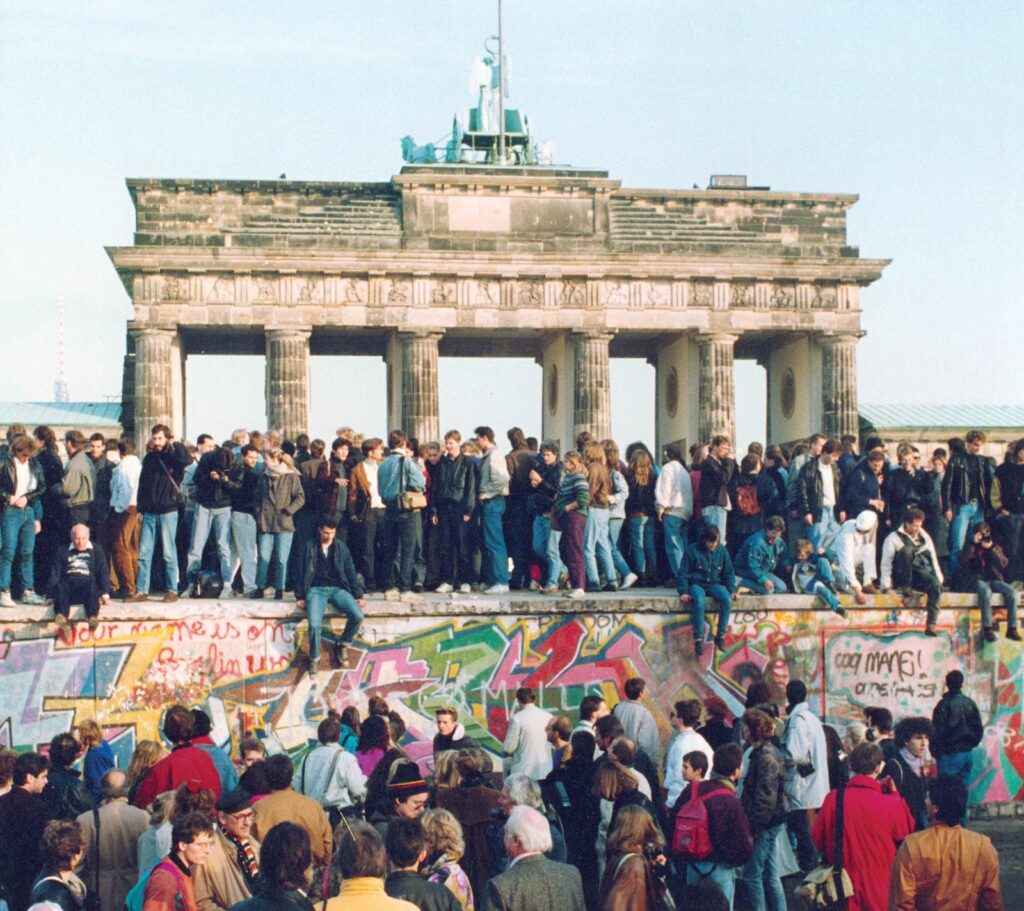
In this three-part interview, conducted, transcribed and edited by Zoltán Ginelli, history professor James Mark talks about his latest book.
James Mark is a British Professor of History at the University of Exeter. His research focuses on the history and memory politics of state-socialism in East Central Europe from the perspective of broader global histories, transnational processes and comparative methods. In 2019, James finished leading two 5-year international research projects: 1989 After 1989: Rethinking the Fall of State Socialism in Global Perspective and Socialism Goes Global: Cold War Connections Between the ‘Second’ and ‘Third Worlds’. The two projects focused on how to reinterpret state-socialism, the Cold War, the 1989–91 system changes and the postsocialist period in Eastern European history as part of global processes and in the histories of colonialism and anti-colonialism. The titles of the two projects came from two published articles.[1] In 2019, these projects published several books, such as 1989: A Global History of Eastern Europe, and Alternative Globalizations: Eastern Europe and the Postcolonial World, but three further volumes are in also production, one of them entitled Historicizing Whiteness in Eastern Europe. Readers might also be interested in the exhibition Tito in Africa: Picturing Solidarity organised as part of the second project and bearing an exhibition book (The Wende Museum, Pitt Rivers Museum, Museum of Yugoslavia). The exhibition presents the African round-trips of Yugoslavian president Tito in the 1960s and 1970s in the context of the development of the Non-Aligned Movement and the Third World. Continue reading “Why Globalise? 1989 in Eastern Europe and the Politics of History”
Marc-William Palen
History Department, University of Exeter
Follow on Twitter @MWPalen
Gemma Clark
University of Exeter
Cross-posted from FORGED BY FIRE: BURNS INJURY AND IDENTITY IN BRITAIN, C.1800-2000
Arson is the criminal act of setting fire to property with the aim to cause damage; yet, whether or not incendiaries also intend to harm people, fires often result in ‘tragedies involving burns and scalds’, as documented by this blog. In November 1991, during the Northern Ireland Troubles, two young arsonists ‘motivated by sectarian hatred’ killed Kathleen Lundy, a Catholic convert through marriage, and her 15-year-old son, Colin, residents of the predominantly Protestant area of Glengormey, near Belfast. (Another son, Gerard, aged 19, was injured.) Mark Whyte, 18, and Richard McKay, 19, claimed at Belfast Crown Court that they believed the family was staying with relatives on the night they ‘poured petrol through the letterbox’ of the Lundy home and ‘set it alight’.[1] In a seemingly-weak defence of a life-threatening act, McKay ‘thumped the dock with his fist and shouted out – “Nobody was meant to die”.’[2] Mr Justice Nicholson ‘had a “slight doubt” as to whether they intended to kill’, sentencing the pair, in February 1993, to concurrent fifteen-year sentences for arson and manslaughter.[3]
As a historian of arson, I explore similarly difficult questions around personal and collective motivations for malicious fire setting, focusing specifically on its function as a tool of protest and intercommunal violence. One of the core and perhaps unexpected findings in my research area, Britain and especially Ireland since c.1800, is that this inherently dangerous strategy has claimed relatively few casualties, especially when compared to modern, sinister usages of fire, such as ethnic cleansing and inter-religious/racial violence, elsewhere in the world.[4] There have been racist and suspected-racist arson attacks in modern Britain; the New Cross house fire, in London, 1981, for example, claimed thirteen young lives and shaped Black British identity.[5] However, the relative scarcity of lethal arson, particularly in the British/Irish protest sphere, is surprising because arguably incendiarism works so effectively – as intimidation and insurgency – precisely because of its lethal potential. Humans learn from a young age ‘that fire can hurt us. It can burn our body and lay waste to our home’;[6] I have found that politically-motivated arsonists historically have traded on this primal fear, of losing everything to the flames, to induce action and compliance with demands. Continue reading “Dangerous but rarely deadly: Fire as protest in modern Ireland”
Laura Sangha
University of Exeter
Cross-posted from The Many-Headed Monster
If you are thinking about decolonising your history module this year, this seminar plan [pdf] might be of use to you. It’s based around ‘Black Lives in Early Modern England’, but with minor tweaking of the reading and primary sources it could be adapted for most modules, whether pre-modern or modern.
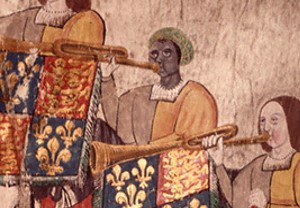
The seminar aims to introduce students to some key concepts whilst also encouraging them to think about methodology and historiography. It combines synchronous and asynchronous activities, and is equivalent to four hours of synchronous seminar time (it’s designed for my Special Subject which in non-pandemic years is taught by means of 2 x 2 hour seminars a week).
In this post, I want to share some of my recent experiences and which provide some context to where the seminar emerged from. Continue reading “Decolonising and Black British History: a teaching resource”
Marc-William Palen
History Department, University of Exeter
Follow on Twitter @MWPalen
|
Date (Term 1) |
Speakers |
Paper Title |
|
23rd September 2020 (Week 1), 15:30h |
Nandini Chatterjee (University of Exeter), in conversation with Gajendra Singh (University of Exeter) |
Book launch: Negotiating Mughal Law a Family of Landlords Across Three Indian Empires (CUP, 2020) |
|
7th October 2020 (Week 3), 15:30h |
Rachel Lin (University of Exeter) & Iacopo Adda (University of Geneva) |
Historical Memory in Sino-Russian Border Museums |
|
21st October 2020 (Week 5), 15:30h |
Joint event with Violence Margot Tudor (University of Manchester) Emily Bridger (University of Exeter) |
Beer, Boxing, and Belly-dancers: Gendering Peacekeepers in Egypt 1956-1967 ‘All Township Love-making is Rough’: Rape as a Contested Concept in Apartheid-era Soweto, South Africa |
|
4th November 2020 (Week 7), 15:30h
|
Crispin Bates (University of Edinburgh) |
Policing Intimacy and Queering the History of South Asian Overseas Migration in the Colonial Era |
|
18th November 2020 (Week 9), 15:30h
|
Beth Rebisz (University of Reading) Gavin Davies (University of Exeter) |
Gendered Geographies of State Coercion in the Late-Colonial Period: Kenya, 1954-1960
‘The Eye’s Great Feast’: Food and Civility in William Darton Jr’s Games of Travelling in Asia and Europe |
|
2nd December 2020 (Week 11), 15:30h |
Nicholas Grant (University of East Anglia) |
Task Force Africa: The NAACP and Black Internationalism in the 1970s |
Marc-William Palen
History Department, University of Exeter
Follow on Twitter @MWPalen
Continue reading “This Week’s Top Picks in Imperial & Global History”
Marc-William Palen
History Department, University of Exeter
Follow on Twitter @MWPalen
Cross-posted from History Matters
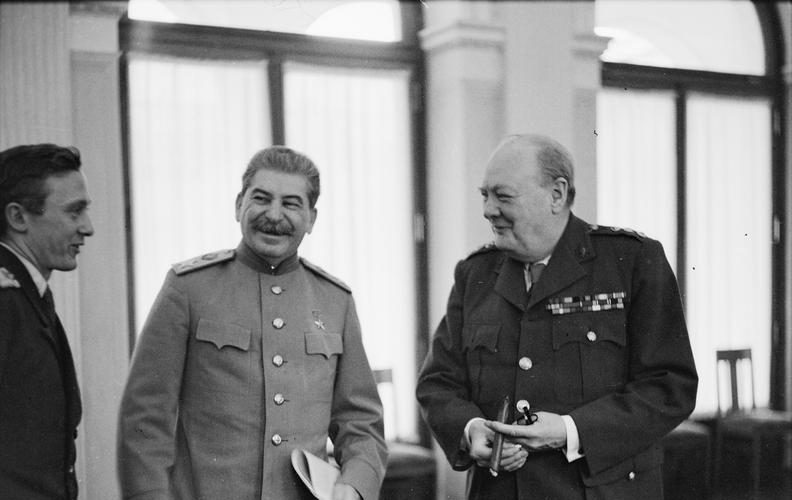
On 23 February 1945 Churchill invited all ministers outside the War Cabinet to his room at the House of Commons to hear his account of the Yalta conference and the one at Malta that had preceded it. The Labour minister Hugh Dalton recorded in his diary that “The PM spoke very warmly of Stalin. He was sure […] that as long as Stalin lasted, Anglo-Russian friendship could be maintained.” Churchill added: “Poor Neville Chamberlain believed he could trust with Hitler. He was wrong. But I don’t think I’m wrong about Stalin.”[1]
Just five days later, however, Churchill’s trusted private secretary John Colville noted the arrival of:
“sinister telegrams from Roumania showing that the Russians are intimidating the King and Government […] with all the techniques familiar to students of the Comintern. […] When the PM came back [from dining at Buckingham Palace] […] he said he feared he could do nothing. Russia had let us go our way in Greece; she would insist on imposing her will in Roumania and Bulgaria. But as regards Poland we would have our say. As we went to bed, after 2.00 a.m. the PM said to me, ‘I have not the slightest intention of being cheated over Poland, not even if we go to the verge of war with Russia.”[2]
At an initial glance, there seems to be a powerful contradiction between these different sets of remarks. In the first, Churchill appears remarkably naïve and foolish, putting his faith in his personal relationship with a man whom he knew to be a mass murderer. In the second he seems strikingly, even recklessly bellicose, contemplating a new war with the Soviets, his present allies, even before the Germans and the Japanese had been defeated.
Surprising though it may seem, the disjuncture is not as large as it appears on the surface. Relations with the USSR and the future of Poland were not the only things that were at stake at Yalta. The Big Three took important decisions regarding the proposed United Nations Organization, and the post-war treatment of Germany, and even Anglo-US relations were not uncomplicated. In this post, however, I want to focus on the Polish issue and the broader question of how Churchill viewed the Soviet Union and its place in international relations more generally. I will outline three key assumptions that governed Churchill’s approach and which explain the apparent discrepancies in his remarks upon his return. Continue reading “‘I Don’t Think I’m Wrong About Stalin’: Churchill’s Strategic And Diplomatic Assumptions At Yalta”
Marc-William Palen
History Department, University of Exeter
Follow on Twitter @MWPalen
Francine McKenzie
Western University
Critics of the leadership and competence of the World Health Organization (WHO) during the Covid-19 pandemic have called for the fundamental reform of the organization. Before the pandemic, the dispute resolution body of the World Trade Organization (WTO) was under fire because its rulings were seen as unsound and over-reaching. These are serious criticisms, but they are not new.
All the major organizations in the UN-system have faced criticism and disgruntled members have periodically withheld funding, blocked proceedings, and threatened to quit. Occasionally they have even followed through. The latest round of criticism raises doubts about whether these organizations can survive in their present form. Before we can assess the shortcomings of these international organizations or evaluate the effectiveness of proposals to reform them, we need to better understand their failures. The history of one organization, the General Agreement on Tariffs and Trade (GATT), the WTO’s predecessor, can help us understand why the international organizations that are integral to the current global order invariably irritate members and disappoint expectations.
A lot has been written about GATT by political scientists, legal scholars, economists, historians, as well as officials and activists. But the organization itself is not well understood. Part of the confusion stems from the volume that has been written about GATT, much of it inconsistent or even contradictory. GATT has been described as a regime, a contract, an inter-governmental treaty, a body of law, a club, a forum, and a consumers’ union. It has been characterized as apolitical, technical, obscure, informal, and ineffective. These definitions and descriptors are not necessarily mutually exclusive, but they obscure the organization’s nature and operations. Contradictory assessments of its work and impact compound the problem. Some have criticized GATT as an instrument of American imperialism, an enemy of the environment, a levelling force that erases local cultures and national distinctiveness, and the cause of unemployment and individual suffering. But others claim it is ‘widely considered to have been one of the most successful – if not the most successful – of the postwar international economic organizations’[1] and ‘perhaps the most important and authoritative of all the current International Organizations and regimes’.[2]
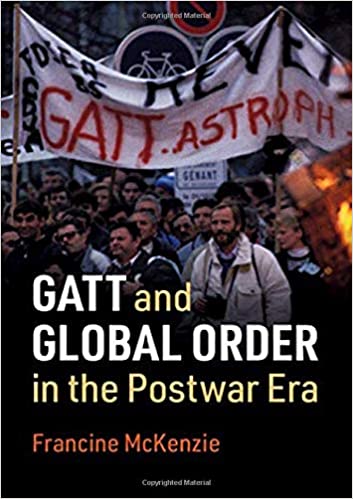
Studies of GATT typically examine one of the eight rounds of trade negotiations conducted between 1947 and 1994. There’s a good reason behind this common approach. Negotiations that lowered tariffs, and later on other kinds of barriers to trade, advanced the organization’s mandate to liberalize and increase international trade. In GATT and Global Order in the Postwar Era, I shift the focus to quotidian and behind-the-scenes institutional activities that expand our understanding of how the organization functioned and the relationship between member states and the secretariat. I also focus on the Cold War, the rise of regional trade blocs, development and agriculture to explore the ways in which trade and politics were interconnected and show how GATT itself was ‘entangled in politics’.[3] Digging deeply into the institutional history revises our understanding of the nature and workings of our current global order. Continue reading “The History of GATT and the Current Crises in the Global Order”
In the twenty years since the publication of Florence Bernault’s edited volume A History of Prison and Confinement in Africa, the study of Africa’s penal systems has expanded tremendously. This scholarship has not only provided a clearer picture of penal ideas and institutions on the African continent across multiple time periods and locations, it has also offered insights into wider questions about the relationship between punishment, colonialism, and decolonization as well as the global circulation of penal techniques. This special issue aims to analyze African developments on their own terms and in relation to imperial and global narratives of punishment and penological networks as well as to integrate the fields of history, sociology, and criminology more closely, highlighting how theoretical insights of sociology and criminology can inform historical research. By presenting multiple works together in a special issue, we seek to emphasize the value of Africanist historical approaches and methods for interdisciplinary or multi-disciplinary research, and to highlight the contribution that studies of African penal systems can make to advancing understanding of global trends in punishment, showing how research on punishment in Africa not only engages with theories from the Global North, but also generates theories that reshape wider approaches to the study of punishment.
Topics for consideration could include (but are not restricted to): indigenous forms of punishment; colonial and postcolonial prisons; capital and corporal punishment; political imprisonment; forced labour; and detention camps.
We are interested in articles undertaking detailed case-study analysis of key historical trends, showcasing different methodological and disciplinary approaches. We invite submissions on all regions of Africa, and its relations with broader global or international developments in punishment and penology.
We particularly welcome submissions from scholars based in Africa and early career scholars. Continue reading “Call for Papers – Special Issue of Punishment & Society: African Penal Histories in Global Perspective”
 Imperial & Global Forum
You must be logged in to post a comment.