
George Roberts
University of Warwick
george.roberts@warwick.ac.uk
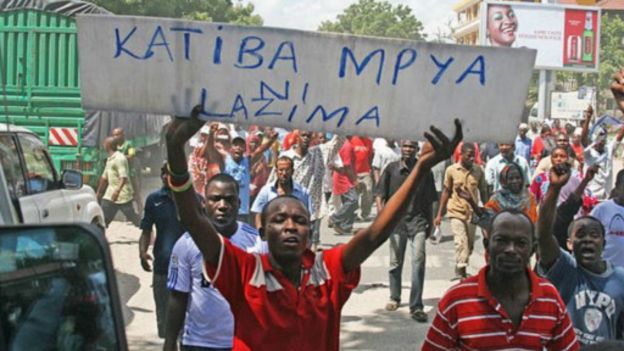
On Sunday, October 25th, Tanzania goes to the polls. This year’s parliamentary and presidential elections appear to be the most closely contested since multiparty democracy returned to the country in 1992. President Jakaya Kikwete will stand down after finishing the second of two five year terms in office. Kikwete’s Chama Cha Mapinduzi – ‘Party of the Revolution’, or CCM – now faces unprecedented competition from an increasingly self-confident opposition coalition. Much of the campaign has consisted of wars-of-words and the making of extravagant promises which any winner would find difficult keeping. Scrape beneath the mudslinging, however, and some central issues emerge. Among them is the question of Zanzibar – a problem rooted in the years of decolonisation in East Africa.
On 12 January 1964, the government of Zanzibar was overthrown in a violent revolution. The island archipelago, which lay a short distance off the coast of mainland Tanganyika, had become independent from Britain just a month beforehand. The ruling Sultan was forced into exile and a new regime under the Afro-Shirazi Party (ASP) took power. Zanzibar’s position at the centre of Indian Ocean trading networks had created a concentrated cosmopolitanism on the islands – a melting pot of competing identities and interests, which spilled over into bloodshed. In the aftermath of the revolution, thousands of Zanzibaris were killed in a wave of violence grounded in long-standing ethnoracial tensions on the islands.
Seen from beyond Zanzibar’s shores, however, the prevailing winds in 1964 were not the monsoon breeze of the spice trade, but the icier fronts of the Cold War. As Jonathon Glassman has shown, during the final years of colonial rule, known locally the zama za siasa (‘time of politics’), Zanzibari politics became superheated with the language of superpower rivalry, the American neoimperialist threat, and the revolutionary dictums of Marxism.[1] Though the revolution was not a communist seizure of power, it was given this veneer by the presence in the new regime of far-left politicians with connections to Beijing and Moscow. Afflicted by Cold War paranoia, Britain, the United States, and other Western states delayed recognising the new ASP government headed by Abeid Karume, fearing the emergence of a ‘Cuba in Africa’. This vacuum was exploited by China, the Soviet Union, and East Germany, which showered Zanzibar with aid and entrenched their influence on the islands. Continue reading “Zanzibar’s Past, Tanzania’s Future: From the 1964 Revolution to the 2015 Elections”






![Image from Journal of a Residence in the Burmhan Empire, and more particularly at the Court of Amarapoorah [Edited by H. C. M. Cox.], p. 328. Courtesy of the British Library.](https://imperialglobalexeter.com/wp-content/uploads/2015/09/image-from-journal-of-a-residence-in-the-burmhan-empire-and-more-particularly-at-the-court-of-amarapoorah-edited-by-h-c-m-cox-p-328-courtesy-of-the-british-library.jpg)


You must be logged in to post a comment.