Reminder: Networks in Imperial and Global History Conference, University of Exeter (June 19-20)

Gareth Curless

The Imperial and Global History Network for early career scholars will be holding its first conference on 19th and 20th June 2014 at the University of Exeter. The conference will bring together early career scholars from across the world, discussing a range of topics including America’s Drone Empire, the anti-Apartheid movement in South Africa, and Treaty Port China. Registration for the conference is now open and information about how to register can be found here.

Where: Reed Hall, University of Exeter

When: 19 and 20 June 2014

Program

Continue reading “Reminder: Networks in Imperial and Global History Conference, University of Exeter (June 19-20)”

Is Global History Suitable for Undergraduates?

world mapMarc-William Palen
Follow on Twitter @MWPalen

Last week, I came across two provocative blog posts, at The Junto and the Imperial and Global History Network (IGHN), on teaching global history that got me thinking reflectively about my own recent experiences of approaching American and British imperial history from a global historical perspective. The big takeaways from both pieces seem to be: 1) teaching global history is a challenge not just for students but for teachers; and 2) that the net positive from teaching history from a global vantage point at the graduate level far outweighs said challenges. However, The Junto’s Jonathan Wilson concludes by quite explicitly questioning whether global historical approaches are in fact suitable for the first-year undergraduate classroom. Continue reading “Is Global History Suitable for Undergraduates?”

Reminder: ‘The Rhetoric of Empire’ Conference, University of Exeter, 22-23 May

Martin Thomas and Richard Toye

rhetoric of empire pic

Continue reading “Reminder: ‘The Rhetoric of Empire’ Conference, University of Exeter, 22-23 May”

The Sino-Japanese War: Dr. Tehyun Ma on BBC’s “In Our Time”

BBC-Radio-4-logoBe sure to listen to the Centre for Imperial & Global History’s own Dr. Tehyun Ma discussing the Sino-Japanese War on BBC Radio 4’s “In Our Time.”

Melvyn Bragg and his guests discuss the Sino-Japanese War of 1937-45. After several years of rising tension, and the Japanese occupation of Manchuria, full-scale war between Japan and China broke out in the summer of 1937. The Japanese captured many major Chinese ports and cities, but met with fierce resistance, despite internal political divisions on the Chinese side. When the Americans entered the war following the bombing of Pearl Harbor, the Japanese found themselves fighting on several fronts simultaneously, and finally capitulated in August 1945. This notoriously brutal conflict left millions dead and had far-reaching consequences for international relations in Asia.

Click here to listen.

ANC Uses History to Sweep South Africa’s 2014 Elections

Emily Bridger
Johannesburg, South Africa
6 May 2014

Reporting from Johannesburg, South Africa, on election day 2014, Exeter’s Emily Bridger argues that the African National Congress’s continued political success owes much to its use of the past and the memory of Nelson Mandela.

Delwyn Verasamy (M&G)

Today, South Africans will go to the polls to vote in their country’s fifth democratic general election. South Africa’s political atmosphere has, since 1994, been characterized by the stubborn persistence of political allegiances, and a deep feeling of loyalty and indebtedness towards the African National Congress, the party that liberated its people from the oppressive conditions of apartheid. This year’s election carries particular historical significance, as it not only marks the twentieth anniversary since the end of apartheid but also the recent passing of the country’s political father figure, Nelson Mandela. While previous ANC election campaigns have focused on the hope for a better future, this year’s campaign has made a decisive rhetorical turn to the past. Likewise, to understand the ANC’s continued success, we must look to the party’s past progress rather than its present scandals. Continue reading “ANC Uses History to Sweep South Africa’s 2014 Elections”

Exeter History Society’s The Historian on the First World War

Arthur der Weduwen & Andrew Eckert
Editors of The Historian, 2013-2014

Historian vol 3

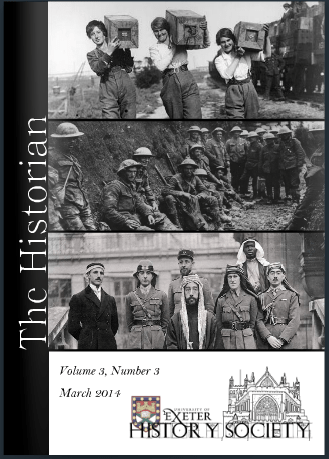
The Imperial & Global Forum is delighted to draw your attention to the most recent volume of the University of Exeter’s excellent student History Society journal The Historian, this one focusing largely upon the First World War.

[From the Editors] We are very pleased to welcome you to the third issue of the third volume of The Historian, the University of Exeter’s History Society Journal. As you may have judged from the cover, this edition largely focuses on the First World War and its centenary, which has dominated the news over the past months. This is the first time that The Historian runs with a specific theme; something we hope will continue in the future. This edition also features several articles unrelated to the First World War, as The Historian remains a journal to which any student can contribute on any topic of historical interest.

Continue reading “Exeter History Society’s The Historian on the First World War”

Fight or Flight: Britain, France, and the Roads of Empire

Cross-posted from Exeter’s College of Humanities News

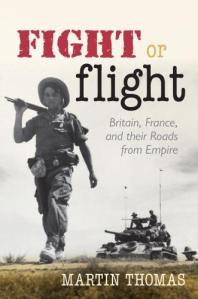
Thomas Fight or FlightA new book by the Centre’s Professor Martin Thomas shows how Britain’s impending withdrawal from Afghanistan and France’s recent dispatch of troops to the troubled Central African Republic are but the latest indicators of a long-standing pattern of decolonisation.

Since 1945 most British and French overseas security operations have taken place in places with current or past empire connections. Most of these actions occurred in the context of the contested end of imperial rule  or decolonisation. Some were extraordinarily violent; others, far less so. Continue reading “Fight or Flight: Britain, France, and the Roads of Empire”

This Week’s Top Picks in Imperial & Global History

Marc-William Palen

From the surprising American support for globalization and remembering the life of an influential U.S. imperial historian, to the fascinating legacies of Dien Bien Phu and the American war in Vietnam. Here are this week’s top picks in imperial & global history.

America’s Role in the World 
Wall Street Journal

Less Military Interventionism, More Trade?

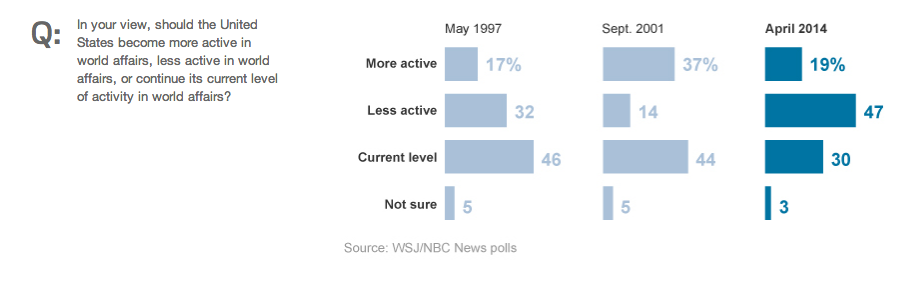
New WSJ/NBC news polls provide what for some might seem to be contradictory opinions regarding how Americans see their country engaging with the globe.

The studies show Americans have consistently opposed military interventionism since 2003. Also, whereas in September 2001 only 14% of respondents felt the United States should become less active in world affairs, the number has skyrocketed to 47% in April 2014.

WSJ poll 1

Continue reading “This Week’s Top Picks in Imperial & Global History”

Humanitarianism on Trial: A Public Lecture

Cross-Posted from Humanitarianism and Human Rights

Centre Director Professor Andrew Thompson will be a visiting scholar at Germany’s Leibniz Institute of European History next month, where he will be giving a public lecture on May 5th entitled “Humanitarianism on Trial.”

Prof. Dr. Andrew Thompson, University of Exeter, will speak at the Leibniz Institute of European History in Mainz on the topic  ”Humanitarianism on Trial. How a global system of aid and development emerged through the end of empire”.

This public lecture will take place on Monday, 5th May 2014, at 06:30 p.m.

BRC

Prof. Thompson will be visiting scholar at the Leibniz Institute of European History in May 2014. His research focuses on the relationships between British, Imperial and Global histories. One major strand of his interests has been the effects of empire on British private and public life during the nineteenth and twentieth centuries. Another has been the study of imperial migrations, including the emigration of people from Britain to the ‘new’ world before 1945, and the immigration of people from Britain’s former colonies after 1945. He has also written about the history of colonial South Africa, informal empire in Latin America, and public memories of empire.

The entrance to the public lecture is free and guests are welcome!

You find additional information at the IEG website:

http://www.ieg-mainz.de/institut/termine-und-presse

How Empires Made Our World

HistoryisNow006cover768x1024

Marc-William Palen

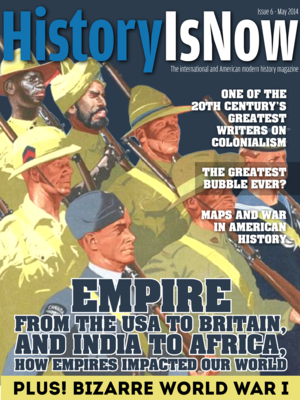
Our good friends over at itshistorypodcasts.com have just published their newest issue of their magazine History is Now; it is entirely dedicated to the historical exploration of empires and their impact today. And we are delighted to see one of the Forum’s own posts, “America’s Absentminded Empire,” has been featured as a syndicated article in the May issue. Be sure to check it out!

[From the History is Now Editor] Welcome to the May issue of History is Now magazine! As you may have guessed from our cover, we’ve done something a bit different this month… Continue reading “How Empires Made Our World”

4 New History Lectureships at Exeter

ExeterThe History Department at the University of Exeter has four new lectureships available.

The result of the 2008 Research Assessment Exercise confirms Exeter’s position as one of the UK’s leading research-intensive universities. Almost 90% of our research is at internationally recognised levels and every single subject submitted included world-leading (4*) research. When adjusted for the 95% of staff submitted, Exeter ranks among the top 15 in the UK for research out of 159 higher education institutions. The Times Higher Education described Exeter as ‘a rising star among research-intensive institutions’.

Lecturer in British and/or Irish History, c. 1800-1922 will contribute to extending the research and teaching profile of modern history at Exeter, particularly in areas related or complementary to political, imperial or colonial history, or in the context of broader global transformations. (Deadline 31 July 2014)

Lecturer in Latin American/Caribbean History, post-1600 will contribute to extending the research profile of colonial/post-colonial/imperial history at Exeter, particularly in areas related or complementary to the history of Empire, colonial/post-colonial conflict, slavery and human rights, US-Latin American/Caribbean relations, relationships to the Cold War or broader global transformations. (Deadline 31 July 2014)

Lecturer in European History, 1450-1750 will contribute to extending the research profile of European History at Exeter, particularly in areas related or complementary to the political, religious, social, economic, cultural, medical, or gender history of Europe in this period. (Deadline 11 May 2014)

Lecturer in Medical History, post-1750 will contribute to extending the research profile of History at Exeter, particularly in areas related or complementary to Imperial, global or transnational medical/scientific exchange. (Deadline 12 May 2014)

This Week’s Top Picks in Imperial & Global History

Marc-William Palen

LawBooksHere are some good reads for your imperial and global weekend: From cartographic colonialism and the socialist origins of capitalism, to new archival photos of Victorian Egypt and reviving Cold War era containment.

Continue reading “This Week’s Top Picks in Imperial & Global History”

British Foreign Policy in the Shadow of a General Election: The Douglas-Home Government

Andrew Holt
Author of The Foreign Policy of the Douglas-Home Government: Britain, the United States and the End of Empire (2014)

Dr. Holt explores the crucial role of the short-lived Douglas-Home Government (1963-64) upon Cold War relations and British decolonization. With the 2015 general elections fast approaching, the story of Douglas-Home also proffers an illustrative historical example of how an impending poll can affect foreign policy.

Holt DouglasHome

Last month marked the fiftieth anniversary of the creation of the United Nations Peacekeeping Force in Cyprus (UNFICYP). Established under Security Council Resolution 186 of 4 March 1964, the force was tasked with preventing further violence between Cyprus’s Greek and Turkish communities in the aftermath of 1963’s ‘Bloody Christmas’. Still in place today, UNFICYP has become one of the longest running UN peacekeeping missions, and it owed much to the diplomacy of the British government of Sir Alec Douglas-Home. It is also just one of many episodes highlighting the significance of Douglas-Home’s short-lived and oft-overlooked administration within the larger histories of Cold War relations and British decolonization. Continue reading “British Foreign Policy in the Shadow of a General Election: The Douglas-Home Government”

Dutch Imperial Past Returns to Haunt the Netherlands

Paul Doolan
University of Zurich and Zurich International School

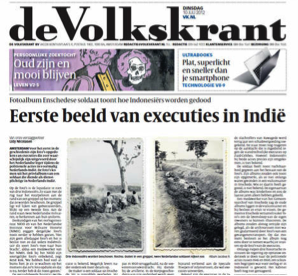
Photos in De Volkskrant July, 10 2012
Photos in De Volkskrant, 10 July 2012.

In July 2012 a Dutch national newspaper, de Volkskrant, published two photos on its front page showing Dutch soldiers brutally shooting and killing unarmed victims in a mass grave. The images were shocking to a nation that prides itself as being upright and humanitarian. Never mind that the photos were nearly 70 years old. Found in a rubbish tip, they were, in fact, the first ever photos to be published of Dutch soldiers killing Indonesians during a war of decolonization that is still euphemistically referred to as a “Police Action.”

Why did it take so long for such images to reach the public? Continue reading “Dutch Imperial Past Returns to Haunt the Netherlands”

The Global Origins of Early Vietnamese Republicanism, Part II

Christopher Goscha
Professor of History, University of Quebec at Montreal

Professor Goscha concludes his two-part Forum exploration of the global origins of Vietnamese Republicanism [Read Part I].

The emperor can be seen seated in an ornate box, upper left, overlooking proceedings of Japan’s new elective parliament, the Imperial Diet. “Illustration of the Imperial Diet of Japan” by Gotō Yoshikage, 1890 [2000.535] Sharf Collection, Museum of Fine Arts, Boston
The emperor can be seen seated in an ornate box, upper left, overlooking proceedings of Japan’s new elective parliament, the Imperial Diet. “Illustration of the Imperial Diet of Japan” by Gotō Yoshikage, 1890
[2000.535] Sharf Collection, Museum of Fine Arts, Boston

The East Asian Origins of Vietnamese Republicanism

Located on China’s long southeastern coastal flank, Vietnam, Korea, and even Japan had long participated in an East Asian civilizational world based on the Middle Kingdom. For centuries overland and maritime routes channeled administrators, Confucian scholars, Buddhist monks, artists, and political theorists to and from the Middle Kingdom and beyond. Vietnam and Korea may have resisted the colonial ambitions of their immense northern neighbor, but they had, like the Gauls dealing with the Romans, borrowed heavily from the Chinese political, social, religious, linguistic, and cultural canon long before Atlantic ideas arrived. Continue reading “The Global Origins of Early Vietnamese Republicanism, Part II”