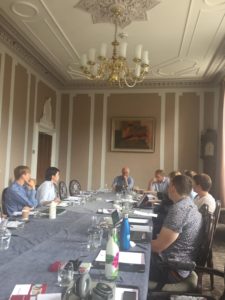
The ‘Bordering on Brexit: Global Britain and the Embers of Empire‘ Conference was held last weekend at Garrison Library, Gibraltar. Professor Richard Toye, Director of Exeter’s Centre for Imperial and Global History, interviews Dr. Olivette Otele (Bath Spa) on the question of contested and controversial history and memorialisation in Bristol.
Interview with Fintan O’Toole – ‘Bordering on Brexit: Global Britain and the Embers of Empire’ Conference
The ‘Bordering on Brexit: Global Britain and the Embers of Empire‘ Conference was held last weekend at Garrison Library, Gibraltar. Professor Richard Toye, Director of Exeter’s Centre for Imperial and Global History, interviews Fintan O’Toole (Irish Times) about his conference keynote.
Interview with Prof. Astrid Rasch – ‘Bordering on Brexit: Global Britain and the Embers of Empire’ Conference
The ‘Bordering on Brexit: Global Britain and the Embers of Empire‘ Conference was held last weekend at Garrison Library, Gibraltar. Professor Richard Toye, Director of Exeter’s Centre for Imperial and Global History, interviews Prof. Astrid Rasch (NTNU) about the conference and the ‘Embers of Empire’ project.
Autumn Term CIGH seminar schedule
The Autumn Term is now upon us, and so please find the Centre for Imperial and Global History seminar schedule below for your calendars.
Please direct any inquiries about attending to the seminar convenor, Dr. Emily Bridger.
|
Date and Location
|
Speaker
|
Paper Title
|
|
26 September (Week 1)
Amory B315, 4:30-6pm
|
Katie Natanel
(Institute of Arab and Islamic Studies)
|
‘Unruly Affects: Tracing Love and Melancholia in Israeli Settler Colonialism’
|
|
10 October (Week 3)
Amory B315,
4:30-6pm
|
Amanda Nettleback
(University College Dublin)
|
‘Colonial Violence and the Limits of the Law’
|
|
24 October (Week 5)
Amory B315,
4:30-6pm
|
Sonia Wigh
(University of Exeter)
|
‘Sex, Secrets, and Savant: Exploring Sexualities in Early Modern South Asia (1650-1750)’
|
|
7 November (Week 7)
Amory B315,
4:30-6pm
|
Ljubica Spaskovska
(University of Exeter)
|
‘Constructing the “City of International Solidarity”: Non-aligned Internationalism, the United Nations and Visions of Development, Modernism and Solidarity, 1955-1975’
|
|
14 November (Week 8)
Amory B315,
4:30-6pm
|
Gabriel Gorodetsky
(All Souls College, Oxford)
|
The Myth of the Grand Alliance in World War II
|
|
21 November (Week 9)
Amory B315,
4:30-6pm
|
Michael Goebel
(Graduate Institute Geneva)
|
‘Patchwork Cities: Urban Ethnic Segregation in the Global South in the Age of Steam’
|
|
5 December (Week 11)
Room TBA,
4:30-6pm
|
Monica Ronchi
(Institute of Arab and Islamic Studies)
|
‘Settler colonialism and the representation of indigeneity: the cases of French Algeria and Israel/Palestine’
|
This Week’s Top Picks in Imperial & Global History

Marc-William Palen
History Department, University of Exeter
Follow on Twitter @MWPalen
From when America needed Syria to fashion rules of the Colonial Atlantic, here are this week’s top picks in imperial and global history.
Continue reading “This Week’s Top Picks in Imperial & Global History”
Shooting Tigers in Early 20th-Century India

Rajarshi Mitra
Indian Institute of Information Technology
During my trip to Exeter to attend the Britain and the World Conference earlier this year, I discovered that the Royal Bengal Tiger on display in the Royal Albert Memorial Museum (RAMM) was a gift from King George V (1865 – 1936). Exeter’s Bengal tiger was one of 39 tigers the King had killed during his hunting excursion in Nepalese Terai in 1911 – the year of his grand Coronation Durbar in India. The accompanying plaque states that the King presented tiger skins to British museums so that visitors who have never seen a tiger could meet one face-to-face. Like any responsible museum, RAMM’s curators have taken care to send a nuanced message through its natural history exhibits. They raise our environmental guilt, they remind us of nature’s destruction in the hands of man. Tiger hunts in India have a rich history of their own, and that Exeter has somehow been made part of that history had me intrigued. Continue reading “Shooting Tigers in Early 20th-Century India”
This Week’s Top Picks in Imperial & Global History

Marc-William Palen
History Department, University of Exeter
Follow on Twitter @MWPalen
From the global ways of white supremacy to the Stalinist Truman Show, here are this week’s top picks in imperial and global history. Continue reading “This Week’s Top Picks in Imperial & Global History”
The Weight of the Past in Franco-British Relations

How does one measure the influence that history has on contemporary affairs and issues? Is it possible to fashion some kind of litmus test, through which we can assess the impact that perceptions of the past have had on the conceptualisation of national and transnational policies? It is questions like these that the AHRC research project ‘The Weight of the Past in Franco-British Relations’ will explore over the next three years. Led by Professor Peter Jackson (University of Glasgow) alongside co-investigators Dr Rachel Utley (University of Leeds) and Dr Rogelia Pastor-Castro (Strathclyde University) and post-doctoral research assistant Dr Rachel Chin (University of Glasgow), this project will assess the role that representations of the past have played in Franco-British relations since 1815. More specifically, it will seek to understand how history, or at least subjective constructions of history, has shaped policy debates in general and prospects for Franco-British co-operation in particular. Continue reading “The Weight of the Past in Franco-British Relations”
This Week’s Top Picks in Imperial & Global History

Marc-William Palen
History Department, University of Exeter
Follow on Twitter @MWPalen
From linking the Irish Revolution and the First World War to today’s lessons from the Warsaw ghetto, here are this week’s top picks in imperial and global history.
Continue reading “This Week’s Top Picks in Imperial & Global History”
This Week’s Top Picks in Imperial & Global History
Marc-William Palen
History Department, University of Exeter
Follow on Twitter @MWPalen
From globalizing ‘Gym Crow’ to the untold story of American isolationism, here are this week’s top picks in imperial and global history. Continue reading “This Week’s Top Picks in Imperial & Global History”
This Week’s Top Picks in Imperial & Global History

Marc-William Palen
History Department, University of Exeter
Follow on Twitter @MWPalen
From black radicalism’s complex relationship with the Japanese Empire to how Soviet tanks shook up the Australian Left, here are this week’s top picks in imperial and global history. Continue reading “This Week’s Top Picks in Imperial & Global History”
Call for Editors – Journal of Global History
Professor William Gervase Clarence Smith, Professor Barbara Watson Andaya, and Professor Merry Wiesner-Hanks will shortly be coming to the end of their tenure as editors of the Journal of Global History (JGH). Cambridge University Press, in collaboration with an Editorial Board search committee, is now inviting applications for their successor(s).
The deadline for applications is 30 September, 2018.
JGH addresses the main problems of global change over time, together with the diverse histories of globalization. It also examines counter-currents to globalization, including those that have structured other spatial units. The journal seeks to transcend the dichotomy between ‘the West and the rest’, straddle traditional regional boundaries, relate material to cultural and political history, and overcome thematic fragmentation in historiography. The journal also acts as a forum for interdisciplinary conversations across a wide variety of social and natural sciences. Continue reading “Call for Editors – Journal of Global History”
This Week’s Top Picks in Imperial & Global History

Marc-William Palen
History Department, University of Exeter
Follow on Twitter @MWPalen
From exporting US economic nationalism to rediscovering the 1860s cotton famine, here are this week’s top picks in imperial and global history.
Continue reading “This Week’s Top Picks in Imperial & Global History”
This Week’s Top Picks in Imperial & Global History
Marc-William Palen
History Department, University of Exeter
Follow on Twitter @MWPalen
From reading Marx on migration to the anti-imperial empire, here are this week’s top picks in imperial and global history. Continue reading “This Week’s Top Picks in Imperial & Global History”
“The present is never present – it is already past. Humanitarian action in an age of reorder” – by Markus Geisser

Cross-posted from Humanitarianism & Human Rights
AHRC Care for the Future, in partnership with Exeter’s IIB and the GHRA 2018, invited Markus Geisser, Senior Humanitarian Policy Advisor at the International Committee of the Red Cross to give a public keynote at the Royal Albert Memorial Museum & Art Gallery Exeter. Markus looks back to a long career as humanitarian practitioner and accordingly he referred in his talk to this long experience.
Markus joined the ICRC in 1999 and carried out his first mission as an ICRC delegate in the Democratic Republic of Congo (DRC). This was followed by several years managing field operations in Myanmar, Thailand, Liberia, Darfur (Sudan) and then again in eastern DRC. From 2006 until 2013, he worked in senior management positions in countries affected by the so-called “Global War on Terror”, first in Iraq and Jordan, then in southern Afghanistan and in Washington DC. From 2013 until 2015, he served as Deputy Head of the division working on humanitarian policy and multilateral diplomacy at the ICRC’s headquarters in Geneva. In March 2015 he joined the ICRC Mission to the United Kingdom and Ireland as Senior Humanitarian Affairs and Policy Advisor.


You must be logged in to post a comment.