4 New History Lectureships at Exeter

ExeterThe History Department at the University of Exeter has four new lectureships available.

The result of the 2008 Research Assessment Exercise confirms Exeter’s position as one of the UK’s leading research-intensive universities. Almost 90% of our research is at internationally recognised levels and every single subject submitted included world-leading (4*) research. When adjusted for the 95% of staff submitted, Exeter ranks among the top 15 in the UK for research out of 159 higher education institutions. The Times Higher Education described Exeter as ‘a rising star among research-intensive institutions’.

Lecturer in British and/or Irish History, c. 1800-1922 will contribute to extending the research and teaching profile of modern history at Exeter, particularly in areas related or complementary to political, imperial or colonial history, or in the context of broader global transformations. (Deadline 31 July 2014)

Lecturer in Latin American/Caribbean History, post-1600 will contribute to extending the research profile of colonial/post-colonial/imperial history at Exeter, particularly in areas related or complementary to the history of Empire, colonial/post-colonial conflict, slavery and human rights, US-Latin American/Caribbean relations, relationships to the Cold War or broader global transformations. (Deadline 31 July 2014)

Lecturer in European History, 1450-1750 will contribute to extending the research profile of European History at Exeter, particularly in areas related or complementary to the political, religious, social, economic, cultural, medical, or gender history of Europe in this period. (Deadline 11 May 2014)

Lecturer in Medical History, post-1750 will contribute to extending the research profile of History at Exeter, particularly in areas related or complementary to Imperial, global or transnational medical/scientific exchange. (Deadline 12 May 2014)

This Week’s Top Picks in Imperial & Global History

Marc-William Palen

LawBooksHere are some good reads for your imperial and global weekend: From cartographic colonialism and the socialist origins of capitalism, to new archival photos of Victorian Egypt and reviving Cold War era containment.

Continue reading “This Week’s Top Picks in Imperial & Global History”

British Foreign Policy in the Shadow of a General Election: The Douglas-Home Government

Andrew Holt
Author of The Foreign Policy of the Douglas-Home Government: Britain, the United States and the End of Empire (2014)

Dr. Holt explores the crucial role of the short-lived Douglas-Home Government (1963-64) upon Cold War relations and British decolonization. With the 2015 general elections fast approaching, the story of Douglas-Home also proffers an illustrative historical example of how an impending poll can affect foreign policy.

Holt DouglasHome

Last month marked the fiftieth anniversary of the creation of the United Nations Peacekeeping Force in Cyprus (UNFICYP). Established under Security Council Resolution 186 of 4 March 1964, the force was tasked with preventing further violence between Cyprus’s Greek and Turkish communities in the aftermath of 1963’s ‘Bloody Christmas’. Still in place today, UNFICYP has become one of the longest running UN peacekeeping missions, and it owed much to the diplomacy of the British government of Sir Alec Douglas-Home. It is also just one of many episodes highlighting the significance of Douglas-Home’s short-lived and oft-overlooked administration within the larger histories of Cold War relations and British decolonization. Continue reading “British Foreign Policy in the Shadow of a General Election: The Douglas-Home Government”

Dutch Imperial Past Returns to Haunt the Netherlands

Paul Doolan
University of Zurich and Zurich International School

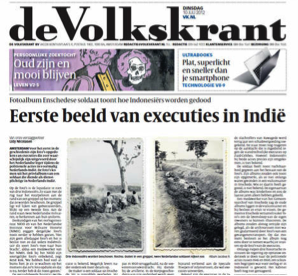
Photos in De Volkskrant July, 10 2012
Photos in De Volkskrant, 10 July 2012.

In July 2012 a Dutch national newspaper, de Volkskrant, published two photos on its front page showing Dutch soldiers brutally shooting and killing unarmed victims in a mass grave. The images were shocking to a nation that prides itself as being upright and humanitarian. Never mind that the photos were nearly 70 years old. Found in a rubbish tip, they were, in fact, the first ever photos to be published of Dutch soldiers killing Indonesians during a war of decolonization that is still euphemistically referred to as a “Police Action.”

Why did it take so long for such images to reach the public? Continue reading “Dutch Imperial Past Returns to Haunt the Netherlands”

The Global Origins of Early Vietnamese Republicanism, Part II

Christopher Goscha
Professor of History, University of Quebec at Montreal

Professor Goscha concludes his two-part Forum exploration of the global origins of Vietnamese Republicanism [Read Part I].

The emperor can be seen seated in an ornate box, upper left, overlooking proceedings of Japan’s new elective parliament, the Imperial Diet. “Illustration of the Imperial Diet of Japan” by Gotō Yoshikage, 1890 [2000.535] Sharf Collection, Museum of Fine Arts, Boston
The emperor can be seen seated in an ornate box, upper left, overlooking proceedings of Japan’s new elective parliament, the Imperial Diet. “Illustration of the Imperial Diet of Japan” by Gotō Yoshikage, 1890
[2000.535] Sharf Collection, Museum of Fine Arts, Boston

The East Asian Origins of Vietnamese Republicanism

Located on China’s long southeastern coastal flank, Vietnam, Korea, and even Japan had long participated in an East Asian civilizational world based on the Middle Kingdom. For centuries overland and maritime routes channeled administrators, Confucian scholars, Buddhist monks, artists, and political theorists to and from the Middle Kingdom and beyond. Vietnam and Korea may have resisted the colonial ambitions of their immense northern neighbor, but they had, like the Gauls dealing with the Romans, borrowed heavily from the Chinese political, social, religious, linguistic, and cultural canon long before Atlantic ideas arrived. Continue reading “The Global Origins of Early Vietnamese Republicanism, Part II”

The Global Origins of Early Vietnamese Republicanism, Part I

Christopher Goscha
Professor of History, University of Quebec at Montreal

National emblem of the Republic of China, 1912-1928. Yuan Shikai (left) and Sun Yat-sen (right) with flags representing the early Chinese republic.

Utilizing a global historical approach, Professor Goscha explores the dynamic origins of Vietnamese Republicanism, in part I of this two-part Forum series.

Just as nationalism, liberalism, and republicanism spread across the Atlantic world in the 18th and 19th centuries, underpinning a series of revolutions stretching from Philadelphia to Paris by way of Port au Prince and Bogota, so too did people, their books, papers, and print technology move such powerful ideas across the Indian Ocean into East Asia with similar effect by the turn of the 20th century.[1] This global transfer of ideas, however, did not move in a straight line. Nor did it necessarily arrive through the colonial connection, even though Euro-American imperial states had colonized much of the Afro-Asian world during this period.

The arrival of Republican ideas to Vietnam is a case in point. Continue reading “The Global Origins of Early Vietnamese Republicanism, Part I”

This Week’s Top Picks in Imperial & Global History

Marc-William Palen

lawrencecamp
A piece of history: This photograph of an armoured Rolls-Royce helped researchers track down a desert camp (pictured) from which Lawrence of Arabia launched guerilla attacks on German-allied Turks.

Ready or not, here is the weekend roundup in imperial and global history:

*It is amazing what still remains to be uncovered at the National Archives. A Bristol University archaeologist has discovered a secret desert camp used by Lawrence of Arabia. It appears to be intact nearly a century later: Continue reading “This Week’s Top Picks in Imperial & Global History”

Writing Human Rights into the History of State Socialism

Ned Richardson-Little
Associate Research Fellow, University of Exeter

One of a number of East German postage stamps commemorating International Human Rights Year 1968. The hammer and anvil represent the right to work.

The collapse of the Communist Bloc in 1989-1991 is viewed as one of the great triumphs of the human rights movement. But this ignores how socialist elites of the Eastern Bloc viewed themselves: not as the villains in the story of human rights, but as the champions. Continue reading “Writing Human Rights into the History of State Socialism”

Contesting History with Jeremy Black

Cross-posted from Bloomsbury History

9781472519504

We all know that history isn’t just about facts; any historical event can be interpreted in a variety of different ways, and these interpretations can be used intentionally to serve particular interests and agendas – agendas which are often set by the state. A national museum, for example, is not a neutral presentation of that country’s history, but its exhibitions are constructed in order to present that nation’s historical self-image. The Asian Civilisations Museum in Singapore – although housed in a building named in honour of Queen Victoria – makes little reference to British imperial rule, instead aiming to reconnect Singapore with its Chinese and Indian cultures of origin. Similarly, Hanoi’s National Museum of Vietnamese History provides a defence of Communism and independence by providing accounts of French imperial cruelty.

These and many other examples from across the globe are discussed in Jeremy Black’s latest book, Contesting History: Narratives of Public History, which we are proud to have published this month. The book provides an authoritative guide to the positive and negative applications of the past in the public arena and what this signifies for the meaning of history more widely. Continue reading “Contesting History with Jeremy Black”

Conference: Trade Unions in the Global South, From Imperial Rule to the Present Day

Gareth Curless

Where: 9am-5.30pm, Friday 13 June 2014, Congress House, London

To mark the important role that trade unions have played in popular protests in Africa, Asia, Latin America, and the Middle East, History & Policy’s Trade Union Forum and the Trades Union Congress will host a one day conference. The conference will reflect on the relationship between trade unions and the state in the Global South, as well as the role of labour movements in popular protests from the end of imperial rule to the present day.

This event is funded by the ESRC. It is free to attend and open to all but space is limited. Spaces will be allocated on a first come, first serve basis. To reserve your place please contact Gareth Curless (g.m.curless@exeter.ac.uk), University of Exeter.  Continue reading “Conference: Trade Unions in the Global South, From Imperial Rule to the Present Day”

Atlantic Empires in Arrested Development

Rachel Herrmann
Lecturer in Early Modern American History, University of Southampton

Arrested DevelopementI’m a firm believer in the idea that we need to hold our students to high standards when we teach history. I am also (perhaps somewhat paradoxically) a firm believer in the idea that to get students enthused about meeting those standards, we need to make history approachable.

And so I sometimes pander.

This semester I’m teaching what is essentially a colonial America class called “Accommodation, Violence and Networks in Colonial America.” I’ve included a week on the Atlantic World—no small feat given the fact that one of my colleagues devotes a whole semester to it—and so I had to grapple with reducing the notion of Atlantic empires into something that was easily digestible. To deal with the problem of summarizing the key identifying features of the Spanish, Dutch, French, and English empires in the early modern period, I turned to the delightfully dysfunctional Bluth family.

For the (woefully) uninformed, Arrested Development follows the trials and tribulations of the California-based Bluth family, a once-wealthy clan that’s fallen from grace, and is composed, for the most part, of terrible, selfish, egotistical people. The show aired from 2003 to 2006, garnered a cult following, and enjoyed a long-anticipated revival season on Netflix last year.

I use Arrested Development at the start of my Atlantic World lecture to paint a broad (and admittedly simplistic) picture of how the different Atlantic empires functioned on their own terms and in their interactions with each other. I should point out that this portion of the lecture takes up no more than five or ten out of our forty-five minutes, but I think it’s worth it because my caricatures provide students with a starting point from which they can challenge what I’ve told them about Atlantic history.  Continue reading “Atlantic Empires in Arrested Development”

This Week’s Top Picks in Imperial & Global History

"An ingenious and labored anti-Darwinian exercise inspired by The Descent of Man of the same date (1871); also a bit of a temperance tract. Original artwork displaying a miniaturist's skill. But for what purpose? The decorative margin and minute detail suggest lanternslide copy. If the figures had been intended as book illustrations BWH would have drawn them directly on the lithographic stone. The skeleton-on-body-silhouette renderings recall those in Hawkins's Comparative view of the Human and Animal Frame" -- Baird. Darwin - Wallace / B. Waterhouse Hawkins, 1871. Image available via Academy of Natural Sciences.
“An ingenious and labored anti-Darwinian exercise inspired by The Descent of Man of the same date (1871); also a bit of a temperance tract. Original artwork displaying a miniaturist’s skill. But for what purpose? The decorative margin and minute detail suggest lanternslide copy. If the figures had been intended as book illustrations BWH would have drawn them directly on the lithographic stone. The skeleton-on-body-silhouette renderings recall those in Hawkins’s Comparative view of the Human and Animal Frame” — Baird. Darwin – Wallace / B. Waterhouse Hawkins, 1871. Image available via Academy of Natural Sciences.

Marc-William Palen

Here are some of the Centre’s top reads for over the weekend:

*Historians are busy exploring why the First World War remains so fascinating to school children. Could it be the war’s angst-ridden poetry?

*The Great War isn’t the only conflict stirring up controversy this year. According to the Globe & Mail, The Conservative Harper government has now been warned by bureaucrats that its planned 110th anniversary commemoration of the Boer War should be peripheral at most. According to documents obtained under the Access to Information Act, civil servants warned:  Continue reading “This Week’s Top Picks in Imperial & Global History”

Adam Smith and Empire: A New Talking Empire Podcast

Marc-William Palen

Wealth of NationsWithin the field of imperial history, Adam Smith’s Wealth of Nations (1776) is commonly associated with the anti-imperial economic doctrine that arose in the mid nineteenth century alongside the rise of Free Trade England. This ideology drew inspiration from Smith’s condemnation of the British Empire for being unnecessarily mercantilistic, expensive, and atavistic. Smith’s critique of imperialism came to be known as “Cobdenism”, named after Victorian free trade apostle Richard Cobden, the anti-imperial radical who led the overthrow of England’s protectionist Corn Laws in 1846.

But the longer imperial legacy of the Wealth of Nations is much more . . . complicated. Smith’s work was transformed into an amorphous text regarding the imperial question throughout the late nineteenth and early twentieth century. Adam Smith had left behind an ambiguous legacy on the subject of empire: a legacy that left long-term effects upon subsequent British imperial debates.

Continue reading “Adam Smith and Empire: A New Talking Empire Podcast”

Human Rights, Neoliberalism, and 1989

Robert Brier
Research Associate, German Historical Institute, Warsaw
Cross-posted from Humanitarianism & Human Rights

“1989” has become shorthand both for the triumph of human rights over state-socialist dictatorship and the subsequent implementation of a “neoliberal” reform agenda. Yet the coalescence of these two phenomena in Eastern Europe twenty-five years ago is quite surprising once we focus on the prehistory of 1989. Following the crooked paths that led to the annus mirabilis is thus a great opportunity to assess the transformation of human rights discourses during the 1980s.

Round Table Talks, Warsaw, Poland, 1989

Twenty five years ago, on 6 February 1989, representatives of Poland’s government and of the illegal democratic opposition began negotiations on political and economic reforms. Inaugurating their meetings at a round table that had been crafted specifically for this occasion, they set events in motion that became a major catalyst for the collapse of the “Soviet bloc.” Continue reading “Human Rights, Neoliberalism, and 1989”

This Week’s Top Picks in Imperial & Global History

Frenchcardgame1
Trading Game: France—Colonies, 1941, O.P.I.M. (Office de publicite et d’impression), Breveté S.G.D.G. Lithograph on linen, 22 7/8 x 32 1/4 in. The Getty Research Institute, 970031.6

Marc-William Palen

From the Getty going free, to card games introducing French children to colonial management, to First World War body armor. Here are the week’s top picks in imperial and global history. Continue reading “This Week’s Top Picks in Imperial & Global History”