
Mitchel Stuffers
Assistant Editor at CIGH Exeter & PhD Candidate in History, University of Exeter
From the struggles of Australia’s Aboriginals to remembering the persecution of Roma and Sinti, here are this week’s top picks in imperial and global history.
In a remote Aboriginal community, a boy asked a question no child should
Dana Morse
ABC News
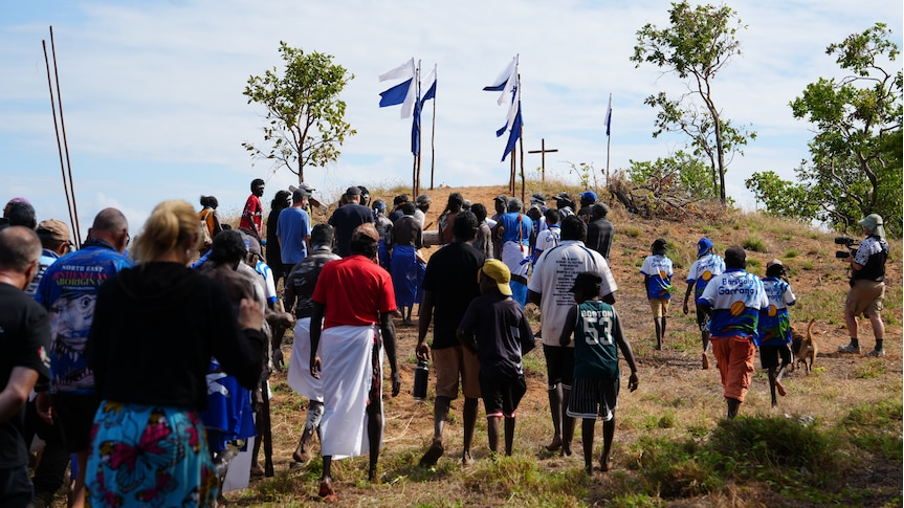
In the tiny community of Baniyala in East Arnhem Land, I sat next to a 13-year-old boy on the porch of a donga that served as a community centre for the day. The taps in the kitchen have been running constantly because there is no hardware store or tradesman there to fix them. The boy was funny, charismatic and deeply proud of his home. He was carrying around a sea rights flag, designed after his elders took their case to the High Court to establish the first native title claim over the coastline of north-east Arnhem Land. He told us confidently that it was his flag to fly. He told me he had brothers and sisters he loves to tease, including one who had passed away just a few years ago.
And then he asked me to guess what colour his coffin was going to be. It was as casual as if he had asked me to guess what footy team he supported, but it pulled me up short. On the one hand, this young boy knows and lives his culture with confidence. On the other, he has seen death so often he has his coffin colour picked out. [Continue reading]
Why Lugdunum (Not Rome) Shaped the Roman Empire in the 2nd Century AD
Kieren Johns
Collector
Collector
In AD 196, the fate of the Roman Empire was decided on a battlefield in southern Gaul. This is how the Battle of Lugdunum changed the course of Roman history. By the late winter of AD 197, the Roman Empire had been wracked by violent civil war for several years. Scores of Roman soldiers had been slaughtered on battlegrounds across the ancient Near East and even in Rome itself. War began in AD 193, but by now, the five rivals for imperial power had been whittled down to just two. The final confrontation would take place at Lugdunum in southern Gaul between Septimius Severus and Clodius Albinus in what would be the largest battle in Roman history.
By AD 180, the Roman Empire had been transformed. At least this was the assessment of senator and historian Cassius Dio. According to Dio, the death of Marcus Aurelius in AD 180 marked the moment when the Empire was transformed from a kingdom of gold to one of iron and rust. The cause of the transformation was not simply the death of the exalted philosopher-emperor, but also the accession of his son, Commodus. [Continue reading]
How is a 60-year-old city linked to 19th Century slavery?
Martin Heath
BBC
Although a village with the same name has been around since the 12th Century, what is now the city of Milton Keynes did not exist until 1967. But an event is taking place on Saturday to “shine a light on the city’s historical connections to slavery [and] anti-slavery movements”. Organised by the African and Caribbean Arts and Heritage Union, the Anti-Slavery Pillar Event, external at Milton Keynes Rose in Campbell Park will feature contributions from the deputy mayor, Thames Valley Police, local teachers and social workers
Some critics have argued on social media that Milton Keynes is simply too young to have any meaningful connections to the slave trade. So where does Milton Keynes fit in to the story of “evil in one of its purest forms”? Clinging on to the edge of Buckinghamshire, and within the city of Milton Keynes, Olney is famous for two things – being the venue for an annual pancake race and being the birthplace of the hymn, Amazing Grace. One of the most popular Christian worship songs, it is a powerful statement of redemption by a man who was very much part of the slave trade. [Continue reading]
Black women and their legacies of civil and human rights activism
Keisha Blain
Brookings
In 2016, Nigerian American activist Ayọ (formerly Opal) Tometi appeared before the United Nations to address state-sanctioned violence. Only three years prior, Tometi had joined forces with queer activists Alicia Garza and Patrisse Cullors to launch Black Lives Matter (BLM). What began as a hashtag on social media evolved into a protest movement that shook the nation to its core. BLM gained national and global attention after the 2014 police shooting of teenager Michael Brown Jr., in Ferguson, Missouri, when the world demanded justice for Brown’s family and unarmed Black people who were killed by police. By spring 2015, BLM marches and demonstrations began to sweep across European cities, including London, Paris, Amsterdam, and Berlin. Within a few months, the movement boasted an estimated 26 chapters across the globe.
As one of the founders of the movement, Tometi had been invited to offer remarks at the UN General Assembly in July 2016. To confront the persistent problems of structural racism and discrimination, the UN had organized a two-day meeting that brought together influential leaders from around the world. Tometi’s presence at the UN underscores BLM’s central role in shaping national and global narratives on human rights in the 21st century. [Continue reading]
Memorial Day of Sinti and Roma: The genocide Europe struggles to remember
Michaela Küchler
EuroNews
Every year on 2nd August, Genocide of the Roma Memorial Day, Europe remembers the hundreds of thousands of Roma and Sinti people persecuted and murdered during the Nazi era. The real question is what happens on 3rd August – and every day thereafter asks Michaela Küchler in an OpEd für Euronews.
Victims of persecution can be lost twice: first when their lives are taken, and then when their names are quietly mislaid by history. For decades, one of the most haunting images of Nazi persecution was known simply as the “girl with the headscarf”. She was filmed looking through the closing doors of a train leaving the Westerbork transit camp and widely assumed to be Jewish. The image became famous. The girl did not. Only years later did historical research restore her identity. Her name was Settela Steinbach. She was Sinti. [Continue reading]


You must be logged in to post a comment.