
Mitchel Stuffers
Assistant Editor at CIGH Exeter & PhD Candidate in History, University of Exeter
From the Mecca Joint Defence Pact explained to the passing of China’s reformist czar, here are this week’s top picks in imperial and global history.
What Is the Mecca Joint Defense Pact—and What It Is Not?
Ali Bakir
Middle East Council
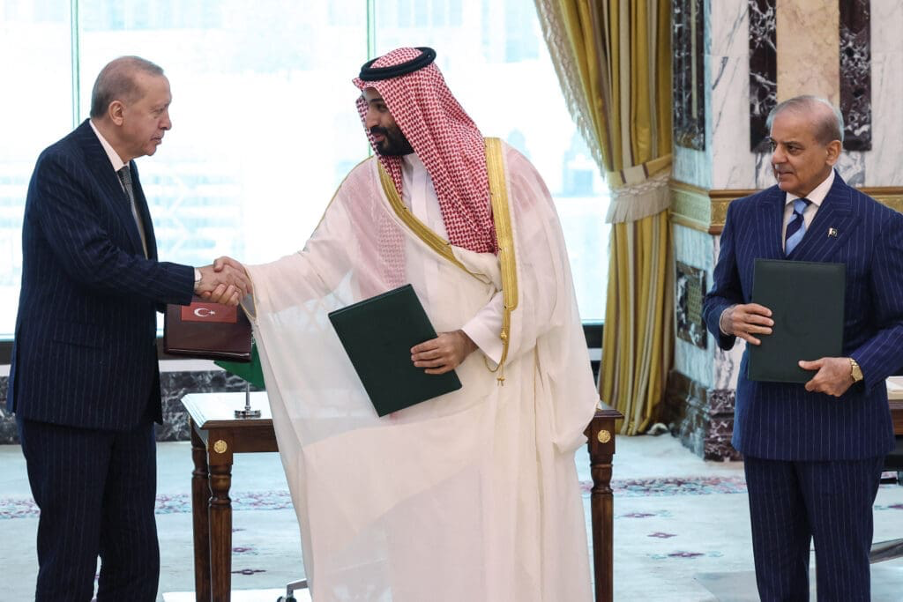
Amid the turmoil of the past few years—and broader geopolitical shifts—three major Muslim powers have agreed to a new framework for their mutual security, while providing a path for others to follow. On August 7, 2026, Saudi Arabia, Türkiye, and Pakistan announced a trilateral mutual defense pact signed in Mecca by Saudi Crown Prince Mohammed bin Salman, Turkish President Recep Tayyip Erdogan, and Pakistani Prime Minister Shehbaz Sharif. The agreement is the outcome of intensive consultations among the three countries and represents a significant step toward closer trilateral security and defense cooperation.
The agreed-upon framework builds on the Saudi-Pakistani defense pact signed in the aftermath of the Israeli attack on Qatar in September 2025, the first attack of its kind against a Gulf state. It also comes amid the Iran-Israel-U.S. war that began in February 2026, and follows Israeli Prime Minister Benjamin Netanyahu’s announcement of what he described as a “Hexagon alliance,” involving Israel, Greece, India, Cyprus, and some members of the Abraham Accords days before the war started. [Continue reading]
Taliban pressured by insurgents after 5 years in power
Masood Saifullah & Zamzama Niazai
DW News
DW News
Less than a month before the five-year anniversary of the Taliban retaking power in Afghanistan, the Islamist regime lost control of the Yaftal-e Payeen district capital in the northeastern province of Badakhshan. The disruption was temporary, but it nevertheless marked the first time the Taliban lost control of a district center since returning to power in August 2021. Reports from Badakhshan also indicated internal clashes among Taliban fighters and fatal attacks on high-ranking Taliban officials.
On August 2, some two weeks after the brief loss of the district center, former Afghan army general Sami Sadat ordered his forces to launch attacks against the Taliban across the country. “Today at 5:00 AM, I ordered all military members of the United Front to begin military operations,” General Sadat said in a video message released from the US, where he has lived since the fall of Afghanistan to the Taliban. Other armed groups, including the National Resistance Front led by the son of the late commander Ahmad Shah Massoud, have been engaged in a continuous armed struggle against the Taliban since 2021. [Continue reading]
Inside the Antarctic expedition that made Shackleton and Scott famous – and paved the way to the South Pole
Ed Armston-Sheret
Conversation
In August 1901 Robert Scott, Ernest Shackleton and more than 40 other men set sail to Antarctica for the first time. On their newly built ship, the Discovery, neither Scott nor Shackleton knew what to expect, nor whether they would come back alive. It was on this journey, the 1901 to 1904 Discovery Expedition, that both men became famous polar explorers.
Yet 125 years later, this expedition does not receive the attention it deserves. Scott and Shackleton’s later journeys attract far greater interest, particularly Scott’s dramatic death on the return from the South Pole in 1912 and Shackleton’s heroic leadership following the sinking of the Endurance in the Weddell Sea in November 1915. In my new book, I place the Discovery Expedition centre stage and show the important role it played in the careers of Scott and Shackleton and in Britain’s understanding of Antarctica. [Continue reading]
Britain abandoned a possible £5.5bn treasure near Gibraltar. Now an explorer says he would go back
Harry Dennis
EuroWeekly
Ten tonnes of gold may have been laying untouched 821 metres below the sea for more than three centuries off the coast of Gibraltar. Britain once backed a search for it, but a furious dispute involving Spain, the Rock and a different shipwreck brought the project to a halt.
The £5.5bn fortune no one has proved exists… yet. HMS Sussex, an 80-gun Royal Navy flagship, sank in a violent storm near Gibraltar on 1 March 1694. Around 500 men died and only two are believed to have survived. The warship was reportedly carrying a secret payment intended to keep the Duke of Savoy allied with England against Louis XIV’s France. British government accounts later described the suspected cargo as gold and silver coins worth an estimated £1 million at the time. Modern calculations have put a possible haul of up to ten tonnes of gold at £5.5 billion in value by today’s standards. No treasure has been recovered yet, so this is still an estimate. [Continue reading]
Zhu Rongji, the ‘economic czar’ who helped turn China into a powerhouse, dies at 97
Editorial Team
CNN
Zhu Rongji, the steely former Chinese premier whose bold economic reforms propelled the country’s rise as a global powerhouse, has died. He was 97. Zhu, who served as premier from 1998 to 2003, died of illness in Beijing on Wednesday morning, according to state news agency Xinhua. He is survived by his wife and their two children.
Known as China’s “economic czar,” Zhu led the country to embrace market liberalization and globalization, steering its transition from a centrally planned backwater to a more open and market-friendly economy. In some ways his death marks the end of a more economically optimistic era for many Chinese who witnessed their country’s sweeping transformation during its reformist years. Those reforms led to huge reduction in poverty, an exploding middle class and a scramble by foreign companies to access the lucrative Chinese market. [Continue reading]


You must be logged in to post a comment.