
Dan Weavers
University of Exeter
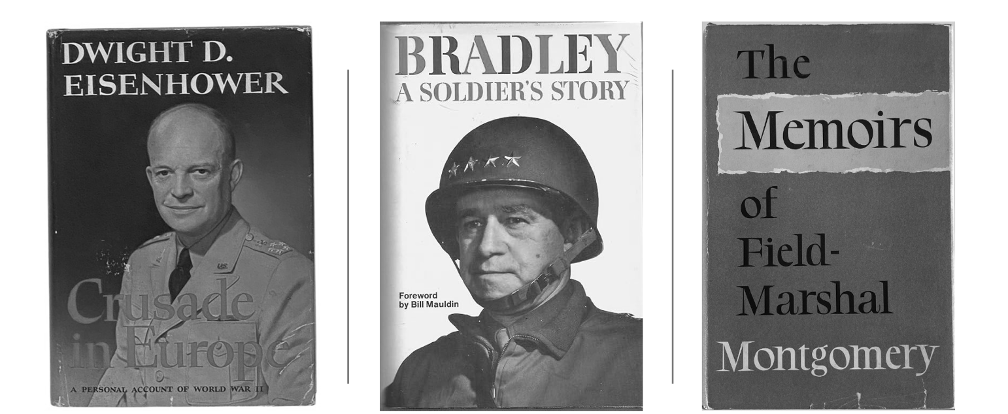
In 1948, US General Dwight D. Eisenhower published his memoir of the Second World War, Crusade in Europe, starting a war of words between American and British allies. Eisenhower’s criticism of Field Marshal Bernard Montgomery in particular produced a wave of indignation in a weakened and declining Britain, whose policymakers were hoping to exchange the moral capital earned from contribution to victory in the war against Nazism to reestablish their global standing and maintain the Empire and Commonwealth.
The symbolic capital of “Monty” was a key source of moral capital for the nation: to insult Monty was to insult Britain. The situation was compounded by the publication of US General Omar Bradley’s A Soldier’s Story in 1951, which presented an escalation in these criticism of Britain’s favourite soldier, just as both countries were once again fighting alongside each other in Korea. Therefore, Eisenhower’s and Bradley’s words were deemed by some in the UK as potentially harmful to the Anglo-American Special Relationship, whilst Britain was desperate for continued American support for British postwar revival.
Britain’s fall from the top rank was reviled not just by the political figures of the day, but also the British military men of the war. Montgomery was not only possessed of vast egotism and self-centredness which fuelled his rage at his former American colleague’s books; he was “always alert to the diminution of British power and influence, and the shrinking of the British Empire distressed him.”[1] He waited until 1958 to publish the vengeful Memoirs, in the aftermath of now President Eisenhower’s repudiation of the British over Suez. As Niall Barr has stated, the “claims and counter-claims” of their memoirs “had the effect of placing in the spotlight the personalities and relationship of Eisenhower and Montgomery almost to the exclusion of every other issue.”[2]
A dedicated study of the commander memoirs of World War II has not yet been made, an indication of how historians have largely discarded them as biased, distorted and unreliable.[3] Frances Houghton’s The Veteran’s Tale (2018) expertly examines the memoirs of the common British soldier but is not a study that encompasses commander books. When viewed through the prism of the Cold War, rather than the Second World War, a whole new perspective of these memoirs can be viewed. Therefore, whilst memoirs have often been dismissed as being of very little value historically, those of the Second World War commanders in fact offer a fascinating window into British postwar imperial anxieties.
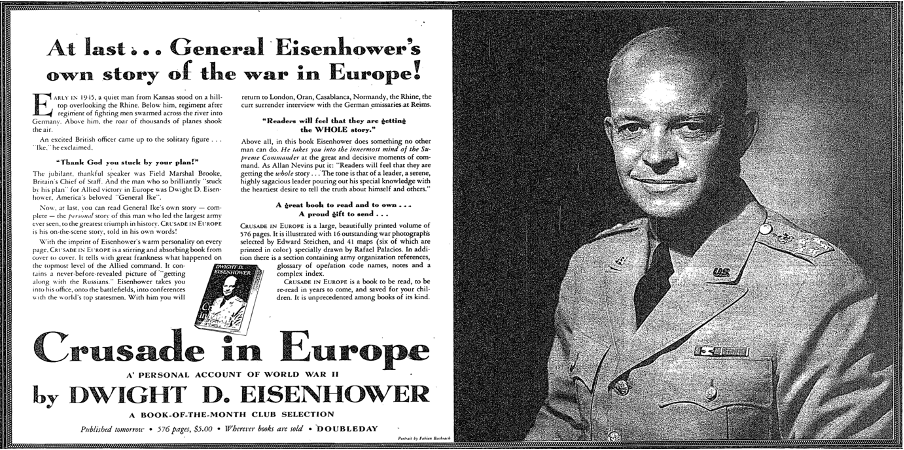
Though Eisenhower’s book was largely fair and even-handed, even towards Montgomery, Ike described how Monty “deliberately pursued certain eccentricities of behaviour,” that resulted in an isolation that would see him “separate himself habitually from his staff”, an act harmful to the processes required to allow the Allied forces to function.[4] Eisenhower also accused Montgomery of tactlessness in his infamous press conference following the Battle of the Bulge. Monty had, in attempting to rouse support for Allied unity, had made it seem that he had personally saved the Americans from collapse and embarrassment. Ike declared that this “caused me more distress and worry than did any similar one of the war. I doubt Montgomery ever came to realize how deeply resentful some American commanders were.”[5] Eisenhower also reflected on the repeated arguments with Montgomery over the Allied strategy and command structure.[6]
Some in the British press were angered at the assault on their favourite soldier. The Sunday Times military correspondent stated, “General Eisenhower considers that the war was really won by America”, and that Ike “forgets to mention that Britain was at war for two years with pitifully inadequate defences while the United States looked on. The plain truth is that Britain suffered losses, offered sacrifices and sustained a burden that was unequalled by any other Allied nation, except possibly Russia, and certainly not the United States.”[7] This offence taken by the author of the review is a reflection of the anxiety around Britain’s reduced global stature, wherein comments disparaging its contribution to victory could damage the attempt to reestablish the global presence Britain felt it had earned.
Other British wartime figures, including Hastings Ismay, Frederick Morgan, Andrew Cunningham, and Charles Portal, leapt to Eisenhower’s defence with their own articles. Churchill considered the fallout from Crusade in Europe was a significant enough issue in transatlantic relations that he declared in the House of Commons that he was “sorry to read the newspaper attacks which have been made in this country” on Eisenhower’s book, before extolling on the American general’s commitment to the Allied cause, a message which he was sure would “be carried to every part of the American public and facilitate the clearing of the atmosphere in regard to this particularly unfortunate episode.”[8] If Churchill felt the need comment, it was clear that Ike’s book had caused significant consternation. The reactions to Ike’s book, in both attack and defence, are indicative of the sensitivity of British feelings towards the impact of the Anglo-American wartime alliance on contemporary geopolitics.
*
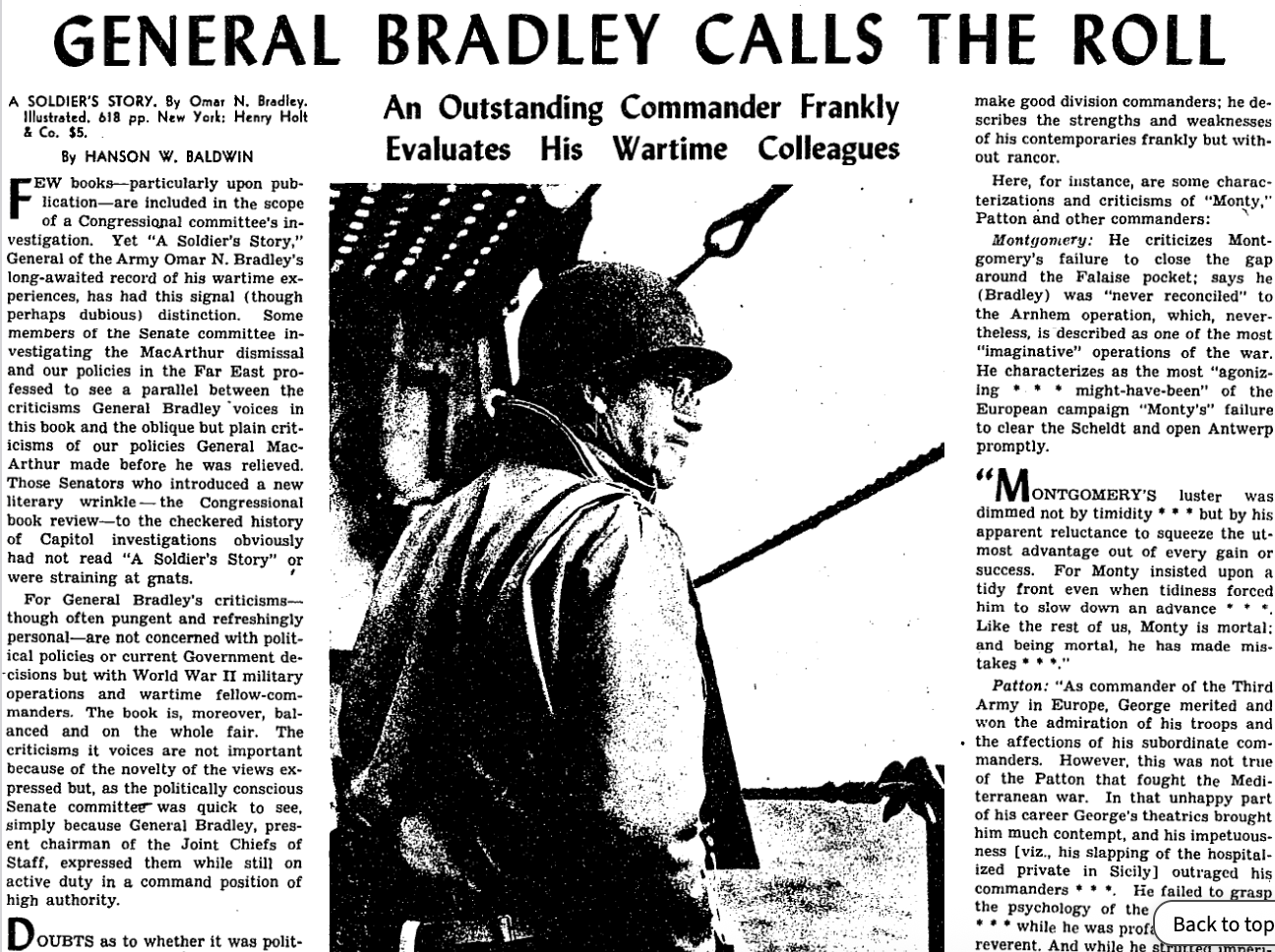
Bradley’s A Soldier’s Story (1951) was not largely of interest due to the author himself; rather it “filled the immediate interest in Bradley’s version of wartime events, especially as a counter to the Eisenhower vs. Montgomery… controversies then raging.”[9]. Bradley created unfavourable impressions of Monty: “Had [Field Marshal Harold] Alexander commanded the 21st Army Group in Europe, we could probably have avoided the petulance that was later to becloud our relationships with Montgomery.”[10]
Bradley’s critiques of Monty, many the same as Eisenhower’s, were no more welcome in Britain than were Eisenhower’s. In writing for the Sunday Times, Lieutenant-General Sir Brian Horrocks wrote that Bradley’s book was “unfortunately written from the narrowest possible angle… from the pen of no less responsible a person than General Bradley, now Chairman of the American Joint Chiefs of Staff.”[11] Horrocks went on to say that “This is certainly not the time for Anglo-American bickering” – likely a reference to the Korean War – a clear cut reflection of the fear held by some that these memoirs critical of Britain’s wartime conduct may be harmful to British-American relations, part of the UK’s insurance against falling from the stage of global power politics entirely.[12]
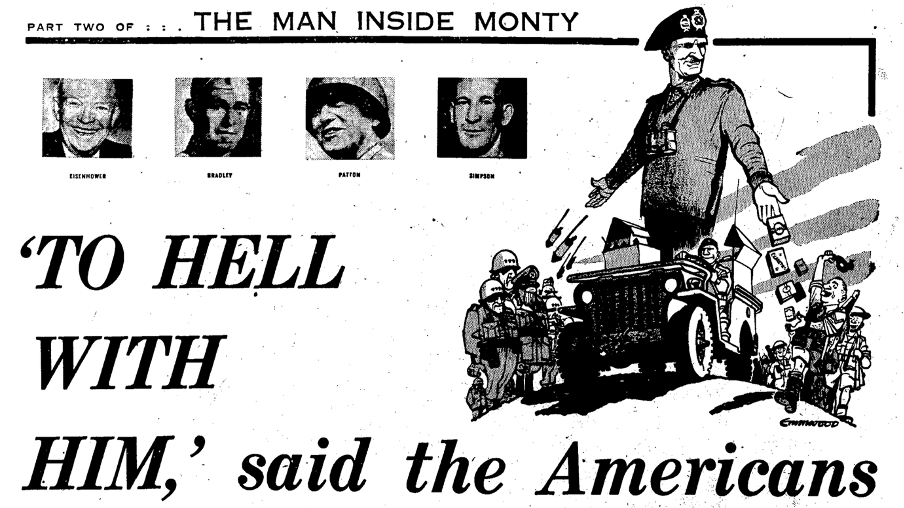
Finally, in 1958, the Field Marshal had his say – and many wished he had not. Though he was troubled by the decline of Britain’s global power, Montgomery’s was driven more by indignation at the portraits painted of him in Eisenhower and Bradley’s memoirs. He depicted Ike and himself as disagreeing on nearly every aspect of the war in Europe. The great furore that Monty’s book created was less over portraits of his American colleagues than in the litany of grievances over the conduct of the war, in which Eisenhower is the preeminent target for attack.
All the same arguments from Eisenhower and Bradley before were employed, with loose adhesion to the truth, in order to reinforce the image of the infallible man of genius that many in Britain had already given Monty.[13] In short, Montgomery stated that “It was very clear to me that Ike and I were poles apart when it came to the conduct of the war.”[14] Moreover, Montgomery sunk to the depths of quoting from Eisenhower’s despatches, in order to childishly refute him and attempt to paint Eisenhower in a poor light.[15] Whilst this was clearly a personal grievance, it should not be discounted that Monty was also frustrated by America’s rise to global dominance at British expense – and Eisenhower was at the helm. For Mongomery, this was hard to accept.
The press coverage did not help. Titles such as “Ike stopped me winning the war in 1944 says Monty” from the Daily Mail is typical of the kind of headline that the book produced.[16] Another Daily Mail article, titled “‘Ike Angry’: End of a wonderful friendship”, is indicative of the great interest in the Eisenhower-Montgomery feud.[17]
British coverage of Monty in the wake of Memoirs also went out of its way to flatter him and often used British history as a way to quantify his greatness. Sir Arthur Bryant, a historian responsible for another Second World War Anglo-American uproar through his use of Lord Alanbrooke’s diaries, wrote: “Montgomery was without doubt the war’s supreme battle commander. Like Wellington he was never defeated,” and his victories would “take their place in our annals with Agincourt, Blenheim and Waterloo.”[18] Such allusions are symptomatic of a Britain in the wake of its last gasp attempt to enforce its will on the world at Suez, and Eisenhower’s repudiation of it. Its failure has been marked by many as the moment that the British superpower, if it had not already fallen, truly no longer existed, and illusions to past grandeur and military victories, whilst tying them to the foremost soldier of the Second World War, demonstrates how the memoirs were not only petty spats of jealousy and rancour between soldiers – they were entangled in the complicated process of British decline and the Anglo-American relationship it helped to shape.
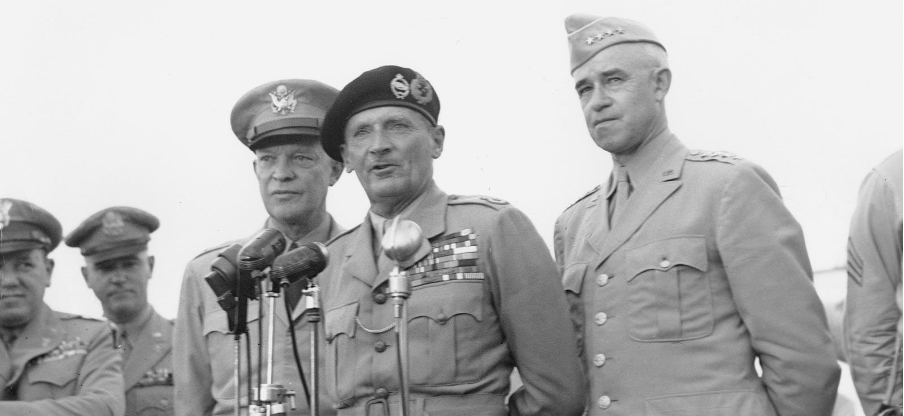
The memoirs of Eisenhower, Bradley, and Montgomery, and the reactions to them, were products rather than catalysts of their time. The fears by some in Britain that the spat between the former allies through their books would cause a rift in Anglo-American relations was never a realistic view. There was not a genuine danger of a split because of what any of them had to say about each other. Rather, the reactions in the press, particularly in Britain, were symptoms of nascent anxieties surrounding Britain’s fall from the table of superpowers. This fact was difficult for many to accept, and for those who had fought to save it from destruction at the hands of the Nazis at great cost in blood and treasure, it was almost impossible.
In this sense, the reactions gave weight to the books that the authors – certainly Eisenhower – never intended them to have. For all, a key motivation was financial. For Eisenhower it was also political, a chance to remind the world of his role as the chief military-political actor in the field in victory over Germany in the lead up to a presidential bid. Bradley’s book was undoubtedly written to try and raise the profile of its relatively unknown author and pre-empt the memoir that an incensed Monty was undoubtedly going to write. Montgomery’s self-centredness trumped his undoubted regret over the end of Empire; he wrote Memoirs primarily as vengeance against Ike and Brad.
Nonetheless, the reactions to the books, fuelled by the belief that Britain’s contribution to victory formed a ready source of moral capital in the postwar struggle and the perceived slights upon it were putting this source in danger, launched them into the all-important but complex Anglo-American relationship that Britain’s decline helped create. For historians, they present a glimpse into the inability by some to accept the setting of the sun on the British Empire.
Dan Weavers is a PhD student at the University of Exeter. His thesis examines the memoirs of Second World War British and American Army Commanders and Moral Capital in postwar Anglo-American relations.
[1] Gary Mead, Montgomery: Unbeatable, Unbearable (Bloomsbury, 2026), p.230
[2] Niall Barr, Yanks and Limeys: Alliance Warfare in the Second World War (Vintage, 2015), p.467
[3] Mark Edmond Clark, ‘Military Memoirs of World War II: It is Not Too late to Write One’, Army History, No. 35, (US Army Center of Military History, 1995), pp.28-31 (p.28)
[4] Dwight D. Eisenhower, Crusade in Europe (Doubleday, 1948), p.286
[5] Ibid.
[6] Ibid. p.306
[7] ‘Eisenhower’s Book: The Facts’, Sunday Times, 21 Nov. 1948
[8] HC Deb, 10 Dec. 1948, Hansard, Vol. 459, cc.703-97 (c.708-10)
[9] Steven L. Ossad, Omar Nelson Bradley: America’s G.I. General (University of Missouri Press, 2017), p.7
[10] Omar Bradley, A Soldier’s Story (Henry Holt & Co., 1951), p.207)
[11] Lieutenant-General Sir Brian Horrocks, ‘Other New Books’, Sunday Times, 27 Jan. 1952
[12] Ibid.
[13] Field-Marshal Viscount Montgomery of Alamein, Memoirs (Collins, 1958)
[14] Ibid. p.262
[15] Ibid. pp.255-6
[16] Jeffrey Blyth, ‘Ike stopped me winning the war in 1944 says Monty’, Daily Mail, 15 Oct. 1958
[17] Wilson Broadbent, ‘‘Ike Angry’: The end of a wonderful friendship’, Daily Mail, 25 Oct. 1958
[18] Sir Arthur Bryant, ‘The Man Who Is Montgomery’, Sunday Times, 21 Sep. 1958


You must be logged in to post a comment.