
This is the first in a series of blog posts created by students of the 2026 ‘Linguistic Landscapes‘ Summer School at Venice International University, in conjunction with the University of Exeter and KU Leuven.
Karin Swahn, Shinhaz F. N. & Wenhan Kang
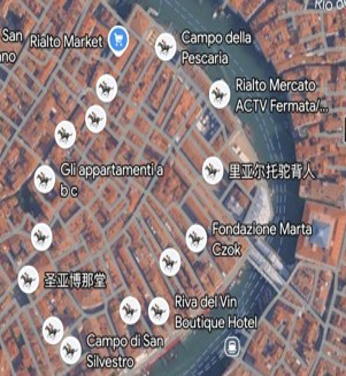
Space can be understood through the interrelated dimensions of perceived, conceived, and lived space (Lefebvre, 1991). Walking through the Rialto Pescheria and Beccarie area in Venice, we encountered the city primarily through the perceived dimension of space. We understood the area through what we saw, heard, and noticed through our senses. As visitors, we experienced the space without inhabiting it as part of our everyday lives and without the planner’s perspective through which urban space is conceived. Wenhan Kang, our only Italian-speaking member, was also the only one who had previously visited Venice, leaving the other two of us to encounter the area as tourists with analytical gazes.
To analyse this, we decided to frame our material through the concept of authenticity. According to Zukin (2008, 2010), authenticity has become increasingly important as a way of marketing and selling urban spaces since the 2000s. Zukin challenges the conventional idea of authenticity as something inherent, traditional, or sincere by presenting it, instead, as a quality that is socially constructed and externally recognised. It does not necessarily represent local residents and often reflects the tastes of the middle and/or upper classes. In this sense, authenticity can function as a form of power that contributes to gentrification and the displacement of an area’s original inhabitants.
What does “authentic” look like in urban spaces? According to Zukin (2008, 2010), it often appears through small shops, “ethnic” restaurants, alternative forms of lifestyle consumption, and carefully constructed narratives attached to venues or products. We know what these narratives look like: “this shop started as a dream between two friends…”, or “our cicchetti continues the fish market’s tradition of combining fresh fish, international influences and old recipes…”. Zukin (2010, p. xiii) describes such authentic spaces as using, “bits and pieces of cultural references: artfully painted graffiti on a shop window, sawdust on the floor of a music bar, an address in a gritty but not too thoroughly crime-ridden part of town.” While this description is rooted in an American context, similar authenticity markers can be found in Venice, for example in wooden signs, chalkboards, and the mixing of Italian and English.
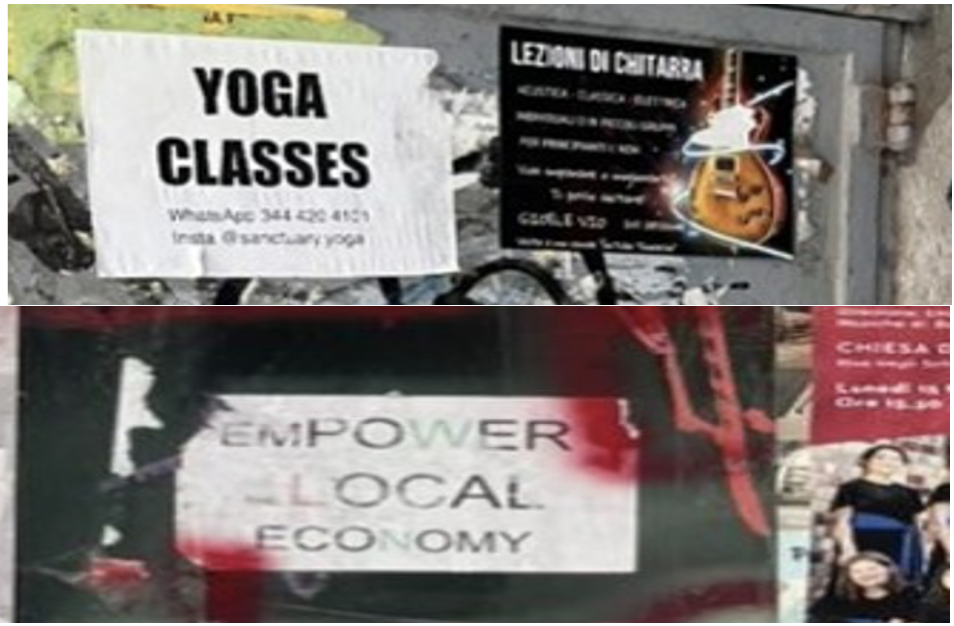
In Venice, tourists’ search for authenticity produces a space that is constantly judged by its appearance, cosmopolitan character, and performance of heritage. It creates a city of heightened representation and romanticisation, in which locals’ lived space is given very little room. Residents often have to navigate streets crowded with tourists who suddenly stop to take photographs. It is, therefore, fitting that Venice has been described as a “museum city” (Blackwood & Tufi, 2015; Tufi, 2017). Venice can also be understood as an assemblage of heterotopias in Foucault’s sense: spaces that are simultaneously real and unreal, situated within time yet somehow outside of it (Foucault & Miskowiec, 1986; Tufi, 2017). In the following, we present our assemblage of authenticities and heterotopias through three themes: heritage as branding, homogeneous door signs and ghost doors, and vernacular authenticity.
Heritage as Branding
The first form of authenticity in our assemblage emerged through the commercial transformation of Venetian history and everyday culture. In Rialto Pescheria and Beccarie, shop names, logos, architectural styles, interior displays, and brand narratives repeatedly drew upon recognisable elements of its past. Signs did more than identify businesses or advertise products, connecting commercial spaces with an imagined Venetian heritage, shaping what visitors, including ourselves, perceived and recognised as the “real Venice.” In this sense, the commercial-linguistic landscape offers an example of how authenticity is constructed from the outside, making it available for consumption.
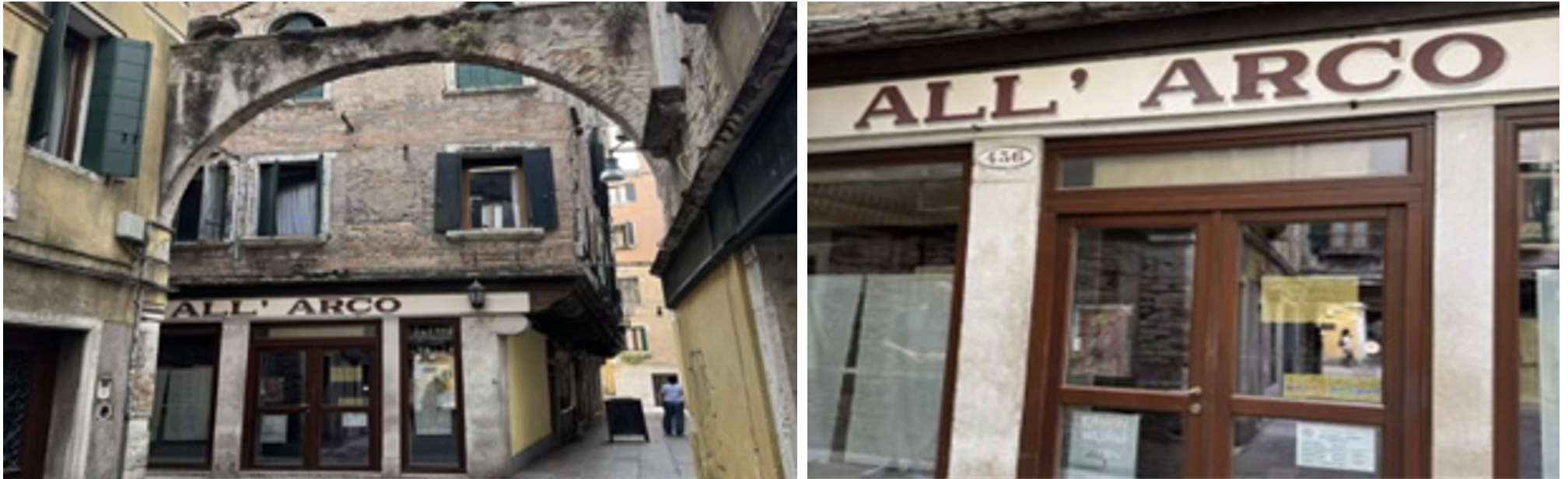
All’Arco, a bacaro (i.e., traditional Venetian wine bar), demonstrates how authenticity can be constructed through the relationship between place, food, and local reputation. Its name refers to the historic arch in the Rialto area, immediately situating it within the material and cultural history of the neighbourhood. During our fieldwork, Liviana, the owner of Livy Wine, a wine bar, explained that All’Arco is well-known among residents for its fresh fish dishes from the Rialto Fish Market. Its authenticity, therefore, depends not only on its name or location, but also on local food practices, community recognition, and stories circulated by people who know the area. Here, history is communicated through a combination of visual identity and local knowledge.
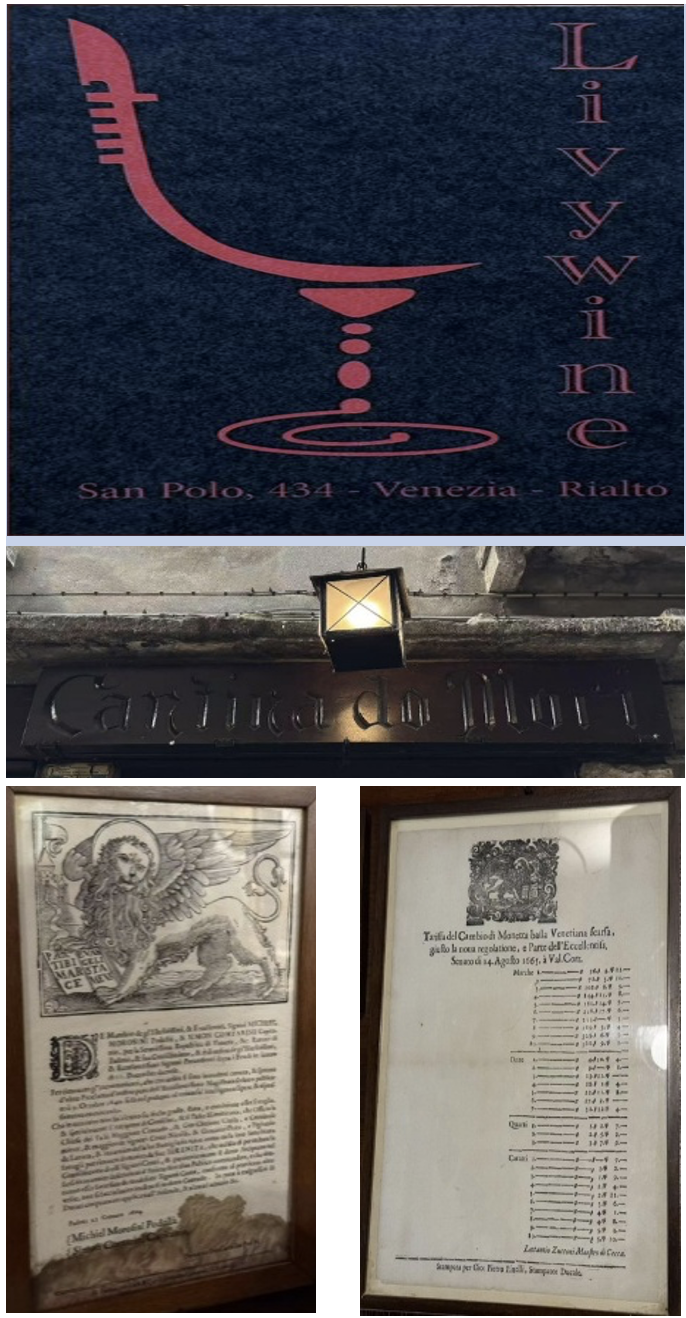
Livy Wine, similarly, transforms an everyday Venetian tradition into a commercial visual identity. Its logo combines the forms of a gondola and a wine glass, two symbols immediately associated with Venice. Although this combination may appear to be a simple branding strategy, the owner Liviana connected it to the historical routines of local fishermen, who, according to her, once worked long hours from approximately three to eight. After returning from work, they would often drink un’ombra di vino, a small glass of wine associated with Venetian daily life, before going home to sleep. Through this story, wine becomes more than a product for sale; it represents a form of cultural memory. The logo condenses this into a recognisable visual symbol that can be communicated to both residents and visitors. At Cantina Do Mori, one of Venice’s oldest wine bars, authenticity is produced through the visible presentation of historical continuity. Documents and other historical materials displayed on the walls function as more than decoration. They operate as visual evidence of the establishment’s connection with the past, encouraging visitors to experience the space as historically rooted.
Other businesses and places adopt different strategies. Traditional and contemporary seafood establishments in Rialto draw upon the same fishing heritage but present it through contrasting visual styles. Hotel Aqua Palace transforms Venetian architectural features into an image of local luxury. Traditional mask shops, likewise, convert the history of Carnival into an immediately recognisable commercial experience. These examples demonstrate that history is not reproduced in a single, stable form. Instead, it is selected and redesigned according to the identity, products, and intended audience of each business.
Together, these examples demonstrate what Zukin (2008, 2010) describes as the commercial construction and consumption of authenticity. The businesses are not only providing wine, food, accommodation, or souvenirs; they are also selling an imagined encounter with the “real Venice”. Yet, Liviana’s experience reveals a contradiction within this process. When asked about everyday life in the city, she recalled living in the historic centre with her mother, but explained that changing conditions eventually led to her move to Mestre (on the mainland). Local memories used to authenticate commercial spaces, therefore, coexist with the gradual displacement of the people who carry those memories.
The contrast between the Venice perceived and consumed by visitors and the lived Venice described by Liviana complicates the commercial promise of authenticity. While businesses continue to select, redesign, and market elements of local history, many residents find it increasingly difficult to remain in the historic centre. Authenticity, consequently, operates both as a valuable commercial resource and as a form of everyday life that residents may feel they are losing.
Homogeneous Door Sign & Ghost Doors
The homogeneous design of door numbers contributes to the visual standardisation and spatial legibility of the urban landscape, creating an organised system for identifying buildings, businesses, and residents. Beyond their decorative function, door numbers form part of an administrative structure that supports navigation, mapping, regulation, and urban management. Historically, house-numbering systems were introduced not only for orientation but also to classify properties and make populations more visible to municipal authorities, tax collectors, and police (Rose-Redwood, 2008; Tantner, 2009). Their uniform appearance, therefore, reflects a broader effort to impose order and consistency on the city.
In contrast, “ghost doors” (i.e., entrances that remain physically visible but no longer lead to active or accessible spaces) disrupt this sense of order by revealing arrangements of earlier architectures. These blocked, sealed, or repurposed entrances reflect the city’s layered history, preserving visible traces of former buildings, uses, and patterns of everyday life within the present urban landscape (Huyssen, 2003). Although they may no longer serve a practical purpose, ghost doors retain symbolic value because they preserve evidence of how a building or street was once used. Together, standardised door numbers and obsolete entrances highlight the contrast between efforts to make urban spaces orderly and functional, and the enduring presence of historical traces within the city.
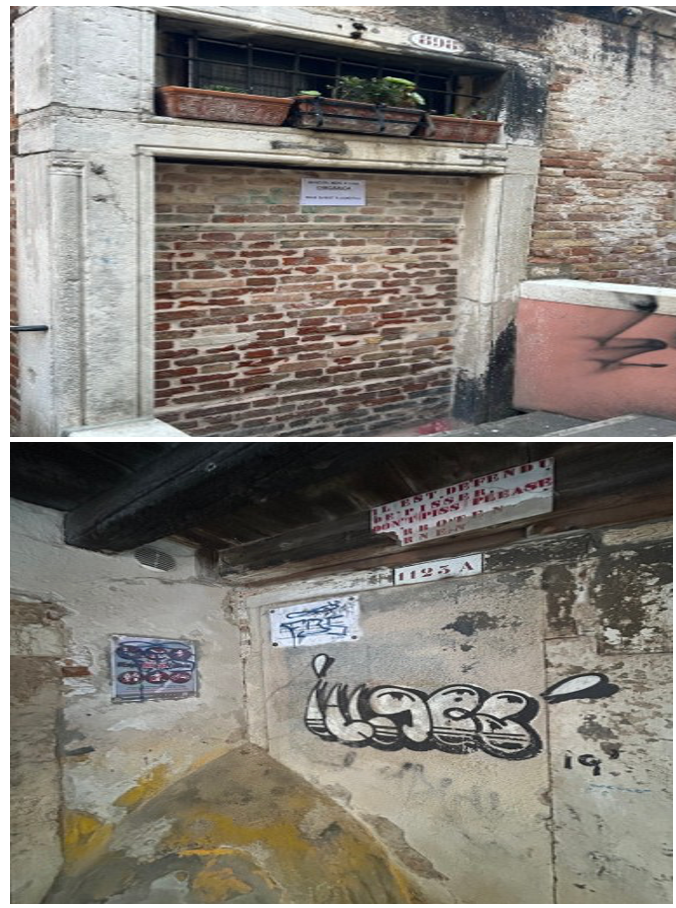
They demonstrate how the city functions as both a space organised for contemporary life and a physical record of adaptation, memory, and continuous architectural change.
Vernacular Authenticity
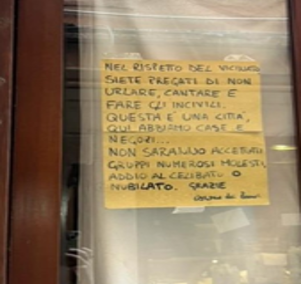
Local markings and handwritten notices in Venice reveal how residents and shop owners use visible language to express identity, frustration, and claims to urban spaces. Research shows that publicly displayed language performs both informational and symbolic functions, communicating messages while also indicating the presence, status, and identity of particular social groups (Landry & Bourhis, 1997). A notice by a local resident illustrates how they use public language not only to regulate tourist behaviour, but also to assert Venice as a lived-in neighbourhood rather than simply a space for consumption and entertainment.
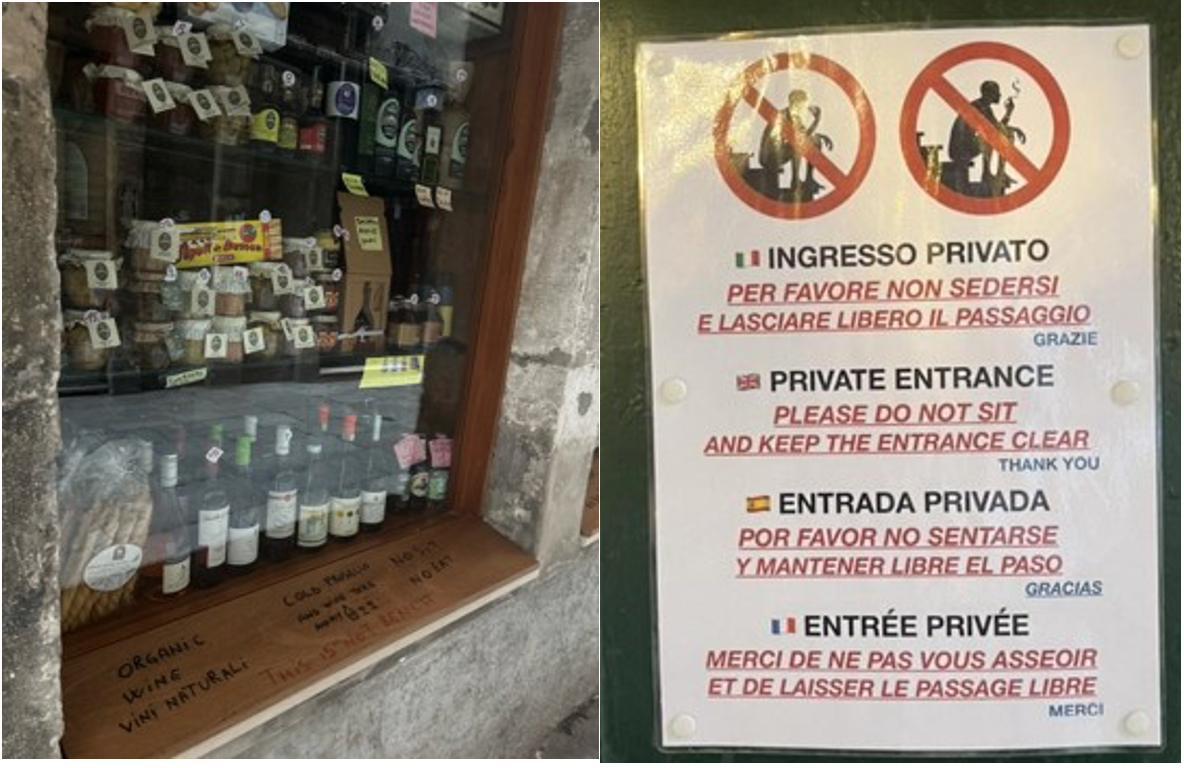
Other examples include shop owners’ handwritten and printed notices (e.g., no sit; no eat; this is not bench; please do not sit and keep the entrance clear, thank you; figure 8) can be understood as locals’ responses to tourist behaviour and an attempt to reassert locals’ voices within a heavily touristic environment.
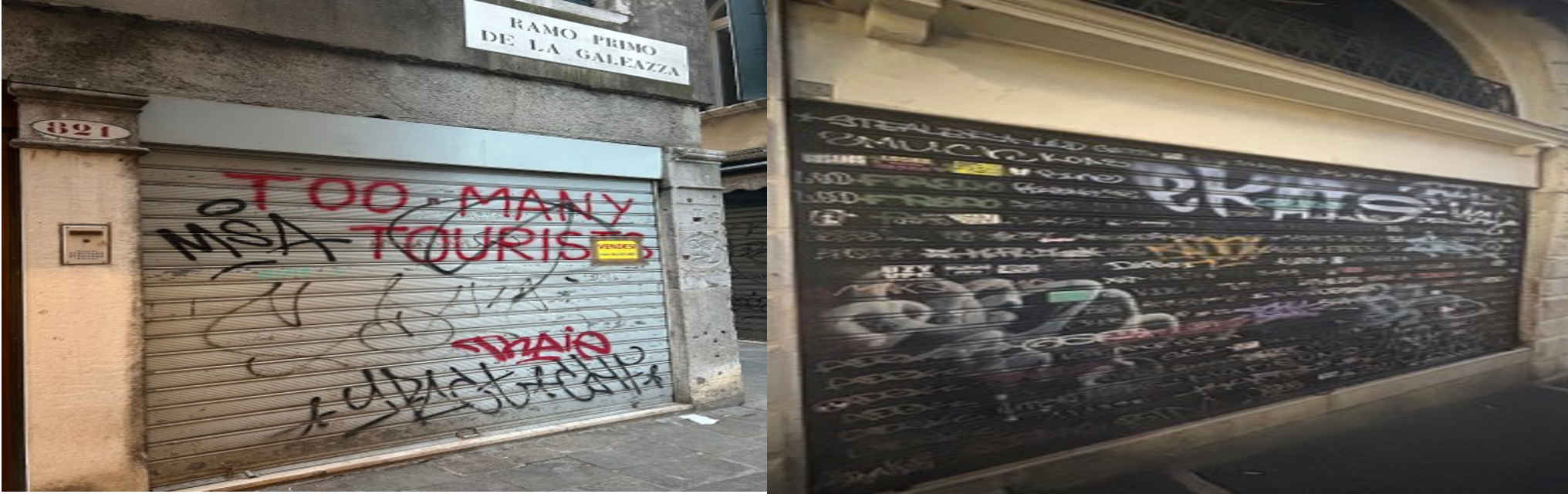
Graffiti provides a further layer of vernacular expression within the city. Its scale and visual form shape how these messages are perceived; large, bold lettering can operate as an immediate and highly visible expression of frustration, while smaller inscriptions create subtler and more personal forms of communication. The use of Italian, English, and other languages also reflects Venice’s multilingual environment, suggesting that some messages are directed towards local communities while others address international visitors. Together, these forms of public expression create a linguistic landscape in which language, imagery, and typography negotiate identity, authority, frustration, and belonging within an urban space (Shohamy & Gorter, 2009).
References
Foucault, M. & Miskowiec, J. (1986). Of Other Spaces. Diacritics 16(1), pp. 22-27. https://www.jstor.org/stable/464648
Franklin, Adrian. 2003. The tourist syndrome: An interview with Zygmunt Bauman. TouristStudies 3: 205–217.
Huyssen, A. (2003). Present Pasts: Urban Palimpsests and the Politics of Memory. Stanford University Press.
Jaworski, A. (2021). Tourism tensions and sociolinguistic change . Applied Linguistics Review, 12(1), 153-164. https://doi-org.ezproxy.ub.gu.se/10.1515/applirev-2019-0105
Landry, R., & Bourhis, R. Y. (1997). Linguistic landscape and ethnolinguistic vitality: An empirical study. Journal of Language and Social Psychology, 16(1), 23–49.
Lefebvre, H. (1991). The production of space. Basil Blackwell.
Rose-Redwood, R. S. (2008). Indexing the great ledger of the community: Urban house numbering, city directories, and the production of spatial legibility. Journal of Historical Geography, 34(2), 286–310.
Shohamy, E., & Gorter, D. (2009). Linguistic landscape: Expanding the scenery. Routledge.
Tantner, A. (2009). Addressing the houses: The introduction of house numbering in Europe. Histoire & Mesure, 24(2), 7–30.
Zukin, S. (2008). Consuming Authenticity: From outposts of difference to means of exclusion. Cultural Studies, 22(5), 724–748. https://doi.org/10.1080/09502380802245985
Zukin, S. (2010). Naked city : the death and life of authentic urban places. Oxford University Press.


You must be logged in to post a comment.