
Mitchel Stuffers
Assistant Editor at CIGH Exeter & PhD Candidate in History, University of Exeter
Mitchel Stuffers
Assistant Editor at CIGH Exeter & PhD Candidate in History, University of Exeter
Mitchel Stuffers
Assistant Editor at CIGH Exeter & PhD Candidate in History, University of Exeter

Mitchel Stuffers
Assistant Editor at CIGH Exeter & PhD Candidate in History, University of Exeter

Mitchel Stuffers
Assistant Editor at CIGH Exeter & PhD Candidate in History, University of Exeter

Mitchel Stuffers
Assistant Editor at CIGH Exeter & PhD Candidate in History, University of Exeter

Mitchel Stuffers
Assistant Editor at CIGH Exeter & PhD Candidate in History, University of Exeter

Mitchel Stuffers
Assistant Editor at CIGH Exeter & PhD Candidate in History, University of Exeter
Mitchel Stuffers
Assistant Editor at CIGH Exeter & PhD Candidate in History, University of Exeter

Mitchel Stuffers
Assistant Editor at CIGH Exeter & PhD Candidate in History, University of Exeter

Mitchel Stuffers
Assistant Editor at CIGH Exeter & PhD Candidate in History, University of Exeter

Mitchel Stuffers
Assistant Editor at CIGH Exeter & PhD Candidate in History, University of Exeter
Mitchel Stuffers
Assistant Editor at CIGH Exeter & PhD Candidate in History, University of Exeter
Mitchel Stuffers, PhD Candidate in History, University of Exeter & Assistant Editor at CIGH Exeter
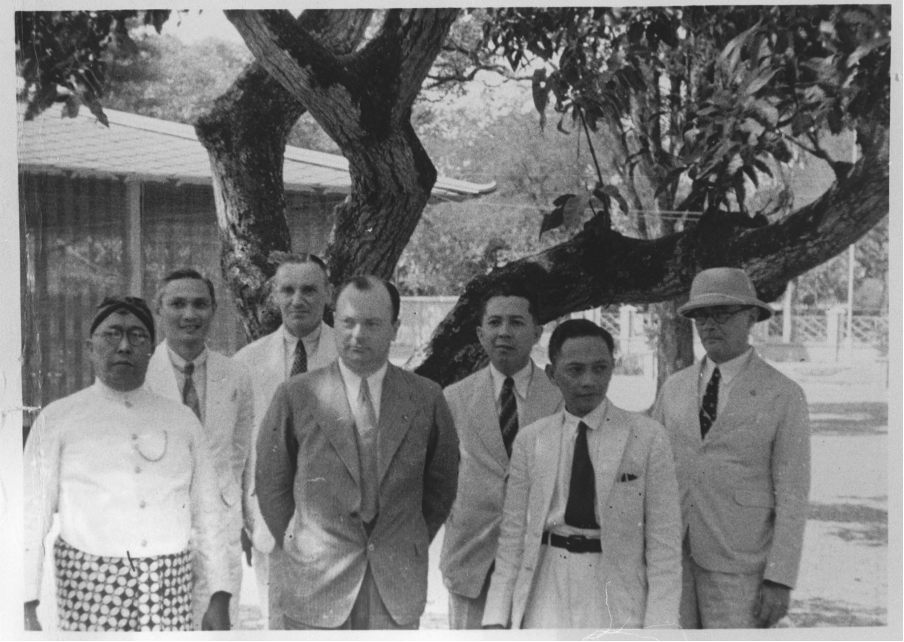
Anton Adriaan Mussert, the leader of the Dutch fascist National Socialist Movement(Nationaal-Socialistische Beweging, NSB), took a 2-month trip to the Dutch East Indies (now Indonesia) in 1935. While there, he agreed to an interview by the colony’s nationalist newspaper Pemandangan, wherein Mussert, remarkably, sought to sell the empire to its anticolonial-leaning readership.
I uncovered the interview while researching my PhD, which integrates imperial & colonial studies and comparative fascist studies by examining how organisations like the Dutch National Socialist Movement(NSB) built, justified, and executed their visions of fascist international worldbuilding. It also draws on Holocaust & Genocide Studies and Intellectual History to gain a more holistic overview of its origins and aims.
Over the last year and a half, I engaged with materials not only from the Netherlands but also pieces from some of its former colonies, like Indonesia, to engage with those inquiries.
Dutch colonial rule over Indonesia, especially before the outbreak of World War Two, was of enough interest to the NSB that its leader had decided to visit it and create an inter-imperial branch to operate from it. The NSB’s efforts to establish a foothold in the colony have led to various arguments among historians. Some claim that Mussert sought to use the Dutch East Indies as a steady stream of funds, and that the Indonesian NSB operated as a mere extension of the motherland’s metropolitan interests.[1] Another scholar reasoned that the NSB had held an “inclusive culturalist notion” of pan-imperial cooperation in its outlook on the colonies, whereby the organisation at large was genuinely impacted, until ethnonationalist chauvinism eventually ended it.[2] The existence of an interview wherein Anton Mussert was transcribed into Indonesian, rather than Dutch, thereby sways us to lean towards the latter hypothesis and examine its peculiarities, wherein an appeal to the colony may reveal its pre-war PR strategies.
Examinations on the NSB more broadly start with insightful works such as those by Edwin Klijn and Robin te Slaa, which, when discussing the NSB’s colonial & imperial aspects, argue that the urge for Lebensraum (Living space) was essentially nullified for the Dutch fascists due to the presence of the colonies before World War Two.[3] More recent historiography includes Tessel Pollman,[4] Jennifer Foray,[5] Geraldien von Frijtag Drabbe Künzel,[6] and Nathaniël Kunkeler.[7] However, it was a note in an older work, from 1968, that led to this short article. Simon L van der Wal briefly mentioned the existence of an interview with the NSB’s Leader, Anton Adriaan Mussert, by a leading Indonesian newspaper;[8] one with anti-colonial, pro-independence leanings.[9] The existence of this interview thereby challenges the way we understand the outreach of ultranationalist groupings to their non-white audiences. It moves us to ask how inter-imperial organisations like the NSB appealed to the wider sphere of colonised subjects, beyond the organisation’s perceived exclusivist dimensions, as has widely been the case in popular memory in the Netherlands following the NSB’s downfall.
Continue reading “How a Dutch Fascist Marketed the Empire in Pemandangan: Mussert’s Indonesian Interview”
Mitchel Stuffers
Assistant Editor at CIGH Exeter & PhD Candidate in History, University of Exeter
Mitchel Stuffers
Assistant Editor at CIGH Exeter & PhD Candidate in History, University of Exeter


You must be logged in to post a comment.